
Table of Contents
ToggleBackground verification is no longer a checkbox activity done at the end of hiring. It has quietly become one of the most critical trust-building processes inside organisations—impacting compliance, workplace safety, brand reputation, and even client confidence.
Yet, for many HR teams, BGV still feels fragmented. Different vendors recommend different checks. Reports come back in inconsistent formats. Decision-making often depends on experience rather than a shared standard.
That’s exactly where the BGV Code of India comes in.
Think of it as a common operating framework—a single reference point that helps HR leaders, founders, and compliance teams design, run, and scale background verification programs with clarity and confidence.
What Is the BGV Code of India?
The BGV Code of India is a structured guide that helps organisations answer four fundamental questions:
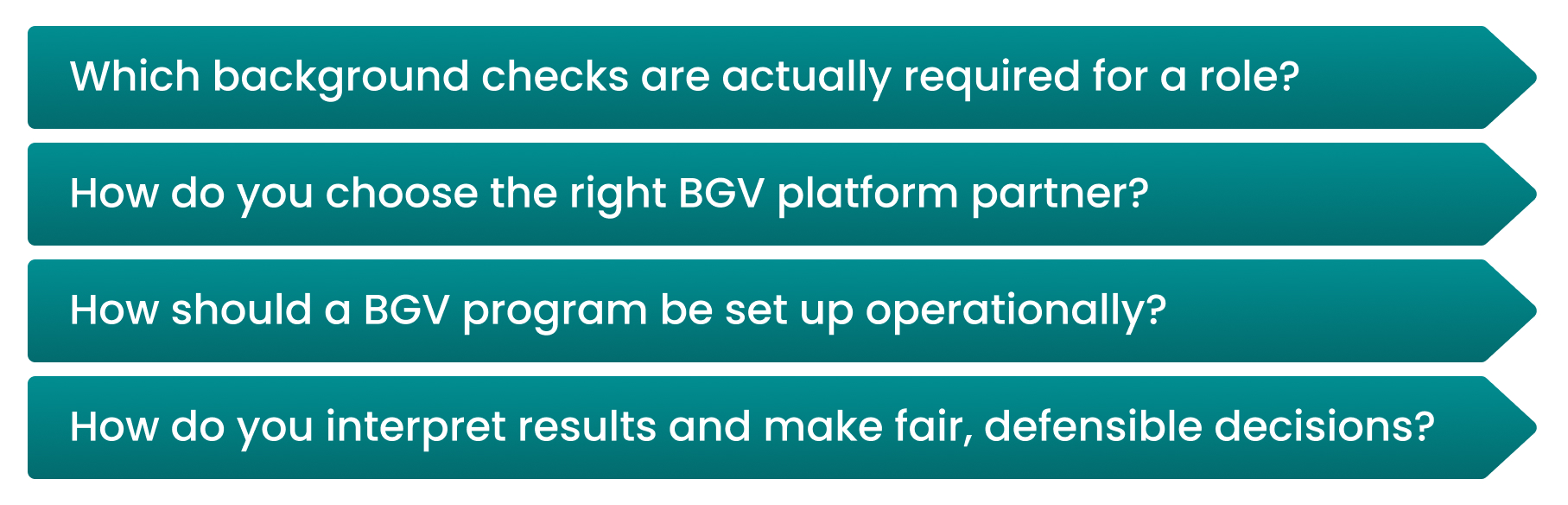
Instead of treating verification as a one-size-fits-all process, the code categorises checks by role type, risk exposure, and regulatory sensitivity—making BGV practical rather than overwhelming.
Core Checks Used Across Most Roles
Some background verification checks form the foundation of almost every verification program, regardless of whether the role is white-collar or blue-collar. These establish basic identity, address authenticity, and employment legitimacy.
Identity Verification (IDV – any two)
Used to confirm that the individual is who they claim to be. Typically combined with other checks for higher confidence.
Read: 7 Most Common Identity Manipulation Tricks (And Why They Still Work)
Address Verification (AV)
Confirms current or permanent residence, helping reduce impersonation and identity misuse risks.
PAN Verification (PANV)
Validates tax identity and helps cross-check name consistency across records.
Voter ID Verification (VIDV)
Driving Licence Verification (DLV)
Passport Verification (PPV)
These strengthen identity assurance, especially when combined with physical or digital address checks.
Criminal Court Record Verification (CCRV)
A critical safety check across most roles, particularly customer-facing or asset-handling positions.
Local Address & Police Variants
Depending on the role and location, organisations may conduct:
- Local Address + Police Address Verification (LAPV / PAPV)
- Local Address + Digital Address Verification (LADV / PADV)
- Local Address Verification (LAV / PAV)
Bank Account Verification (BAV)
Ensures salary payments go to legitimate accounts linked to the candidate.
Employment Health Check (EHC)
Used to validate overall employment readiness where required.
Employment Reference Check (EREF)
Provides behavioural and performance context beyond documents.
These checks together form the baseline BGV layer—sufficient for a large percentage of operational roles.
Checks Commonly Added for White-Collar Roles
As roles move into knowledge-intensive, decision-making, or client-facing territory, verification depth increases.
Employment Verification (EMPV – last two employers)
Confirms tenure, designation, and exit status to reduce résumé inflation.
Education Verification (EDUV – highest qualification)
Validates academic credentials that directly impact role eligibility.
Professional Reference Checks (PRC – two previous managers)
Adds qualitative insight into integrity, reliability, and work ethic.
CV Verification (CVV)
Ensures consistency across submitted information.
Credit-Related Checks
CREC (Credit Records, where applicable)
Used selectively for finance, trust, or asset-sensitive roles.
Social Media Check (SMC)
Looks for reputational or behavioural red flags already in the public domain—handled carefully to avoid bias.
Enhanced Due Diligence for Senior & Regulated Roles
Leadership positions, roles serving multinational clients, or those governed by strict compliance standards require deeper scrutiny.
PVSD – Verification that may lead to Police Clearance Certificate (PCC)
Drug & Health Screening
DRGT (5-panel / 7-panel / 9-panel tests depending on role sensitivity)
Watchlist & Sanctions Screening
NSORC – National sex offender registry checks
OFACC – Sanctions and watchlist screening
These checks protect not just the organisation, but also clients, partners, and downstream ecosystems.
Understanding BGV Results: The Language of Outcomes
Terminal Results
- Success – All checks verified with no issues
- Success with Exception – Minor deviations, low risk
- Probable Discrepancy – Needs review or clarification
- Failed – Material mismatch or adverse finding
- Closed (Stopped) – Candidate withdrew or process halted
- Unable to Verify (UTV) – Verification could not be completed
Non-Terminal States
In Progress
On Hold
Data Insufficient
This structure helps HR teams make consistent, auditable decisions—especially important when handling disputes or audits.
Why the BGV Code Matters for HR Teams
The real value of the BGV Code of India isn’t in the checklist—it’s in standardisation.
- It removes guesswork from deciding “how much verification is enough.”
- It aligns HR, compliance, and leadership on shared definitions.
- It creates fairness by applying the same verification logic across candidates.
- It makes vendor evaluation easier by clearly mapping checks to needs.
Most importantly, it shifts BGV from a reactive task to a proactive risk management function.
Final Thoughts
Background verification sits at the intersection of trust, compliance, and people operations. When done poorly, it creates friction. When done well, it becomes invisible—but powerful.
The BGV Code of India exists to make “doing it well” repeatable.
For organisations scaling teams, working with sensitive data, or building long-term credibility, a structured BGV approach is no longer optional—it’s foundational.
To understand more about setting up a BGV program in your organization, reach out to partner@ongrid.in.
FAQs
1. Is background verification required for all roles?
Not all roles need the same depth, but some level of verification is essential for every hire.
2. How many checks are too many?
Checks should match role risk. Over-verification can slow hiring and harm candidate experience.
3. What does “Success with Exception” mean?
The check is largely verified, with minor deviations that usually don’t pose material risk.
4. Can BGV be run after joining?
Yes, many organisations run staggered or post-joining checks, especially for non-critical roles.
5. How should HR handle discrepancies?
By reviewing context, giving candidates a chance to clarify, and documenting decisions clearly.
6. Are social media checks mandatory?
No. They are optional and should be used carefully to avoid bias.
7. How often should verification standards be reviewed?
At least annually, or whenever business risk profiles change.
8. Does a failed check always mean rejection?
Not necessarily. Decisions should consider severity, relevance, and role context.
9. What’s the biggest BGV mistake companies make?
Treating verification as a vendor-driven process instead of an internal policy-led one.
10. Can small teams also follow the BGV Code?
Absolutely. The framework is designed to scale up or down based on organisational size.






Leave a Reply