
Table of Contents
ToggleIn each boardroom debate today, the phrases “return on investment” (ROI) drive decisions. If it’s technology uptake, marketing expenditure, or hiring, leaders seek to measure value before investing resources. And yet, when it comes to background verification (BGV) and trust-related measures, the ROI conversation takes a back seat.
Verification remains in the eyes of many a compliance checkbox—a regulatory nicety, not a growth driver. But in fact, verification is much more than an administrative function. When done correctly, it protects reputation, lowers fraud losses, speeds up hiring, and establishes the type of trust that translates most directly into financial results.
The question is: How do we calculate the ROI of verification?
Verification as a Strategic Investment, Not a Cost
Consider verification like insurance in personal finance. No one likes paying premiums, but when disaster strikes, the worthiness becomes unavoidable. Verification protects organisations from risks that can creepily chew away profits and brand value.
Firms that treat verification as a strategic investment rather than a sunk cost gain in several ways:
- Reduced exposure to fraud → saving immediate monetary losses.
- Improved, quicker onboarding → enhancing productivity.
- Regulatory compliance → preventing penalties and reputational loss.
- Increased trust with customers, investors, and regulators → driving long-term value.
Taking a big-picture view, verification brings both cost savings and growth enablement.
The Tangible Costs of Avoiding Verification
To truly value ROI, it’s worth attempting to quantify the cost of not verifying.
- Payroll Fraud: Ghost workers or overpriced salaries can siphon crores from company funds every year.
- Penalties for Non-compliance: Regulators in BFSI, insurance, and fintech are strengthening norms. Non-compliance will attract fines, suspension, or even cancellation of licenses.
- Damage to Reputation: One such failure to hire a person with a fake degree or criminal background can destroy customer confidence.
- Operational Inefficiency: Without confirmed addresses and contacts, delivery fails, loans get defaulted, and collections get delayed.
When ROI from Verification Becomes Tangible
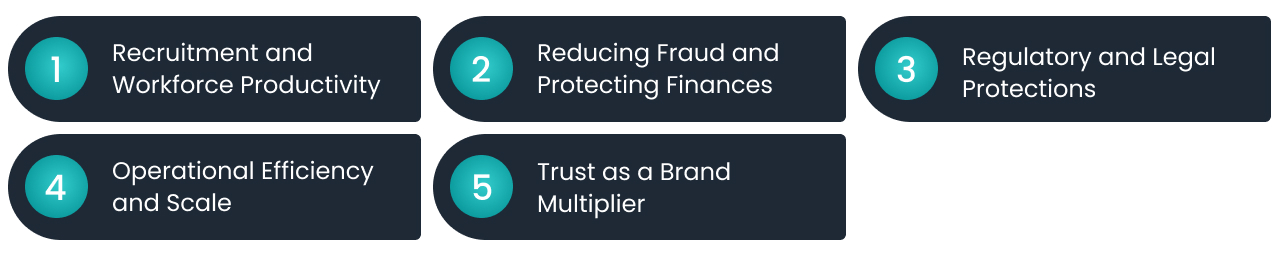
1. Recruitment and Workforce Productivity
Each bad hire costs money—not only in hiring expenses, but in lost productivity, training, and cultural disruption.
A Bogner & Partner report puts the cost of a single bad hire at as much as 5 times an employee’s salary per year. Verifying education, employment history, and criminal background, organizations avoid such errors in the early stages.
ROI in this case isn’t theoretical—it’s real cost saving plus quicker, more assured hiring.
2. Reducing Fraud and Protecting Finances
In BFSI, fintech, and digital-first enterprises, verification stops fraud at the source.
- Identity validation confirms customers to be genuine.
- Address verification minimizes loan defaults and delivery failures.
- Income validation enables underwriting better, preventing bad lending.
- Even a 5% drop in fraud cases can mean crores in savings every year for big businesses.
3. Regulatory and Legal Protections
For sectors regulated by RBI, SEBI, IRDAI, or international standards like FATF, verification is not a choice.
The ROI in this case is to avoid penalties and ongoing license to operate. In tightly regulated industries, compliance itself is a competitive advantage.
4. Operational Efficiency and Scale
Digital-first platforms and Verification APIs slash turnaround times by orders of magnitude.
- Weeks-long onboarding now requires minutes.
- Address checks are done digitally instead of physically.
- HR and risk teams spend less time on manual labor.
This speedup works exponentially over time, releasing bandwidth for growth-oriented activities.
5. Trust as a Brand Multiplier
The single least appreciated ROI of verification is the intangible yet potent currency of trust.
When customers, employees, and investors have faith in your organisation to work with integrity and due diligence, it builds loyalty and long-term value. In competitive markets, trust is typically the separator between a brand that multiplies and one that plateaus.






Leave a Reply