
Table of Contents
ToggleHiring decisions often look straightforward on the surface. A few interviews, a strong resume, maybe a couple of internal discussions—and the offer goes out. But behind every confident hiring decision is a quieter process of validation. This is where the conversation around background check vs reference check becomes relevant.
At first glance, the two seem interchangeable. Both are conducted toward the final stages of hiring. Both aim to validate what a candidate has shared. And both are meant to reduce risk. But in reality, they serve very different purposes—and understanding that difference can significantly improve the quality of hiring decisions.
Two checks, two very different lenses
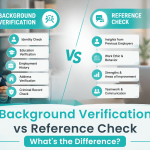
A background check is rooted in verification. It deals with facts—objective, document-backed information that can be validated through reliable sources. It answers questions like: Did this person really work at the company they mentioned? Do they hold the degree they claim? Is their identity consistent across official records?
A reference check, on the other hand, is rooted in perspective. It’s about conversations—usually with past managers or colleagues—to understand how the candidate performed, behaved, and contributed in previous roles.
Put simply, if a background check tells you what is true, a reference check helps you understand what it was like.
This distinction is subtle, but important. Because hiring is not just about accuracy—it’s also about fit.
The nature of information: objective vs interpretive
One of the clearest ways to understand the background check vs reference check difference is by looking at the kind of information each provides.
Background checks rely on verifiable data. Documents, databases, institutional records—these are the sources that shape the outcome. The result is usually binary. Either the information matches, or it doesn’t.
Reference checks operate in a much more fluid space. They depend on human input. A former manager’s opinion, a colleague’s recollection, a client’s feedback—these are inherently subjective. Two people can have very different views about the same candidate, and both can be valid.
This doesn’t make reference checks unreliable. It just means they need to be interpreted with context.
For hiring teams, this difference matters. One process reduces factual uncertainty. The other helps navigate behavioral ambiguity.
Where each fits in the hiring journey
In most organizations, reference checks tend to happen slightly earlier than background checks, though the sequence can vary.
Reference conversations often take place when a candidate is close to selection, but before the final offer is locked in. They help hiring managers get a sense of working style, strengths, and potential concerns that may not surface during interviews.
Background checks usually follow the offer stage. They act as a final layer of validation before onboarding. This is where documents are collected, credentials are verified, and records are cross-checked.
Understanding this flow helps clarify another aspect of the background check vs reference check debate—they are not substitutes. They are complementary steps in the same journey.
Depth vs reliability
Reference checks often go deeper in terms of insight. A well-conducted conversation can reveal nuances that no document ever will. How does the candidate handle pressure? Are they collaborative? Do they take ownership?
These are not things you can verify through records.
But depth doesn’t always equal reliability. Reference checks come with their own set of limitations. Candidates typically share contacts who are likely to speak positively about them. Even when companies try to go beyond provided references, responses can be guarded.
Background checks, in contrast, may not offer depth, but they offer consistency. The information is standardized, verifiable, and less prone to bias.
This is why the background check vs reference check conversation is not about choosing one over the other. It’s about balancing depth with dependability.
The risk perspective
From a risk standpoint, background checks play a more direct role.
They help identify discrepancies that could have legal, financial, or reputational implications. An unverified identity, a falsified degree, or an undisclosed employment gap—these are risks that can materially impact a company.
Reference checks rarely operate at this level. They are less about risk mitigation and more about expectation setting.
For example, a reference might highlight that a candidate prefers structured environments or struggles with ambiguity. This doesn’t disqualify the candidate, but it helps the hiring team make a more informed decision.
In that sense, background checks protect the organization, while reference checks refine the decision.
The candidate experience
There’s also a noticeable difference in how candidates perceive these processes.
Background checks are generally seen as formal and procedural. Candidates expect them. They understand that documents will be requested and verified. As long as communication is clear, this step is usually straightforward.
Reference checks feel more personal. They involve conversations about the candidate, often without their direct involvement. This can make some candidates uneasy, especially if they are not currently open about their job search.
For companies, handling this sensitively is important. Informing candidates in advance, seeking consent, and being transparent about the process can go a long way in building trust.
Interestingly, when done right, both checks can enhance the candidate experience. They signal that the organization values diligence and fairness.
Common misconceptions
A common misconception in the background check vs reference check debate is that one can replace the other.
Some companies rely heavily on reference checks, assuming that a strong endorsement is enough. Others focus only on background verification, believing that factual accuracy is sufficient.
Both approaches leave gaps.
A candidate can have perfectly valid documents and still struggle in a team setting. Conversely, someone with great references may have inconsistencies in their credentials that need attention.
Another misconception is that reference checks are always positive. While many references do tend to be favorable, experienced hiring managers know how to read between the lines. Hesitation, vague responses, or overly generic praise can be just as telling as direct criticism.
The role of technology
The way background checks are conducted has evolved significantly. What used to take days or weeks can now be completed in hours. Digital identity verification, API-based employment checks, and real-time database access have transformed the process.
Reference checks, however, have remained largely human-driven. While there are tools that structure and record feedback, the essence of the process is still conversational.
This difference further highlights the background check vs reference check contrast. One is becoming increasingly automated and scalable. The other continues to rely on human judgment.
For growing organizations, this creates an interesting dynamic. Background verification can scale with hiring volume. Reference checks require time, attention, and skill.
Why both matter more in today’s hiring landscape
The modern workforce is more fluid than ever. People move roles quickly, work across geographies, and build careers that don’t always follow predictable patterns.
In such an environment, relying on a single layer of validation is risky.
Background checks ensure that the fundamentals are in place. Identity, education, employment—these are the building blocks of trust.
Reference checks add a layer of interpretation. They help answer questions that documents cannot—how the candidate works, collaborates, and adapts.
Together, they create a more complete picture.
And that’s really the goal. Not just to verify, but to understand.
The bottom line
The conversation around background check vs reference check is often framed as a comparison. In reality, it’s a combination.
One brings structure. The other brings nuance. One confirms facts. The other reveals context.
Hiring, at its core, is about making decisions under uncertainty. No single process can eliminate that uncertainty entirely. But the right combination can reduce it significantly.
When companies treat background checks and reference checks as complementary rather than interchangeable, hiring becomes more than just a selection process. It becomes a well-rounded evaluation—one that balances evidence with insight.
And in a hiring environment where both speed and accuracy matter, that balance is what makes the difference.




Leave a Reply