
Table of Contents
ToggleThere’s a special kind of email that lands in an HR inbox and instantly changes the mood of the day:
“Hi, I’d love to explore opportunities to come back.”
It’s a former employee. Someone who knows the systems, the culture, the inside jokes about the temperamental office printer. A “boomerang employee.” And in today’s job market, they’re not rare — they’re becoming part of a broader workforce trend where careers are fluid, not linear.
For hiring managers, bringing back a known performer can feel like a shortcut to certainty. Less ramp-up time. Cultural fit has already proven. Lower hiring risk. But beneath that comfort lies an important question many organizations gloss over:
If you verified them once… do you really need to verify them again?
The short answer: often, yes.
The long answer is where things get interesting.
The Rise of the Boomerang Workforce
Not long ago, leaving a company carried an unspoken finality. Today, career paths look more like webs than ladders. People leave for higher studies, startups, family moves, better roles, or just to try something new. A few years later, they return — sometimes with sharper skills and broader perspective.
From an employer’s point of view, this is great news. Rehiring former employees can mean:
- Faster onboarding
- Lower hiring costs
- Stronger retention (boomerangs often come back more committed)
- Institutional knowledge that never really left
But while familiarity creates comfort, it can also create blind spots.
The Myth of “We Already Know Them”
Here’s the assumption that quietly creeps into rehire decisions:
“They worked with us before. We’ve already done their background check. What could have changed?”
A lot, actually.
People don’t pause their lives when they leave an organization. They work elsewhere, relocate, take on financial commitments, start businesses, or face personal challenges. Their risk profile, credentials, and circumstances may look very different from when they first joined.
Verification isn’t just about catching wrongdoing. It’s about ensuring the information you rely on for hiring decisions is current, accurate, and relevant to the role today — not the role they held three or five years ago.
Time Changes More Than We Think
Let’s break this down with a simple lens: time.
Even a gap of 18–24 months can make previous verification outdated. Over longer periods, the gaps grow wider:
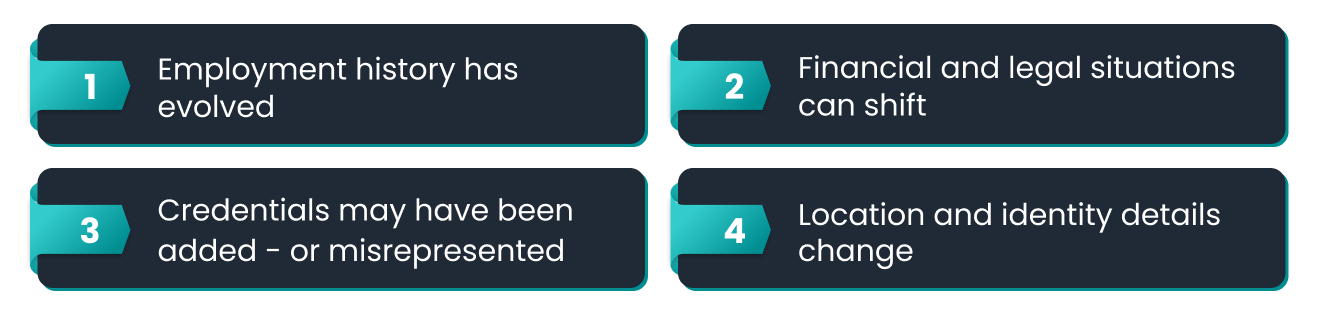
1. Employment history has evolved
They’ve worked at one or more organizations since leaving. Those roles matter. The responsibilities they handled, the way they exited, and the references from those employers all add important context. Skipping verification means ignoring a significant chapter of their professional story.
2. Financial and legal situations can shift
Depending on the sensitivity of the role — especially in finance, leadership, or data access — changes in financial stress or legal issues can be relevant. What was true years ago may not be true today.
3. Credentials may have been added — or misrepresented
Candidates sometimes return with new degrees, certifications, or claims of major projects. Most are genuine. Some are exaggerated. A light re-verification protects both the organization and the individual from future disputes.
4. Location and identity details change
New addresses, new documents, even name changes. These details feed into compliance and audit trails. Relying on old data creates administrative and regulatory gaps.
Time doesn’t automatically equal risk — but it does equal uncertainty. Verification exists to reduce that uncertainty.
“But Won’t This Feel Like We Don’t Trust Them?”
This is the emotional side of the debate, and it’s valid.
Boomerang employees often return with goodwill. Being asked to go through checks again can feel awkward if handled poorly. But the issue isn’t trust in the person — it’s consistency in the process.
The moment exceptions become common, organizations create exposure. If one rehired employee is later found to have undisclosed issues, and it turns out they were not re-verified while others were, it becomes hard to defend that decision internally or legally.
Framing matters. When positioned correctly, re-verification becomes:
- A standard policy, not a personal suspicion
- A compliance step, not a trust test
- A mutual protection measure, not a hurdle
Most professionals understand this, especially when they’ve worked in structured organizations before.
Risk Depends on Role, Not Just Relationship
Not every rehire carries the same level of risk. The need and depth of re-verification should align with what the person will be doing now, not just who they used to be.
Higher-sensitivity roles may warrant more thorough checks:
- Finance and payments
- Access to customer data
- Leadership and decision-making authority
- Compliance and regulatory functions
- Roles involving vulnerable populations
If someone returns into a position with broader access or authority than before, relying on an old report becomes even harder to justify.
On the other hand, for lower-risk roles and short rehire gaps, organizations may choose a lighter, faster verification process. The point isn’t to repeat everything blindly — it’s to reassess what’s relevant now.
The Compliance Angle Most Teams Miss
Beyond risk, there’s a quieter issue: auditability.
Many industries operate under tightening compliance expectations. When auditors, clients, or regulators review hiring processes, they don’t evaluate based on how well you knew the person. They evaluate based on whether your process was consistent, documented, and defensible.
Imagine explaining this in an audit:
“We didn’t re-verify because the employee used to work here.”
That may sound reasonable internally. On paper, it can look like a gap in control. Especially in sectors like BFSI, healthcare, or large enterprises, consistent verification practices are part of the broader trust infrastructure of the organization.
Re-verification creates a fresh, timestamped record that shows due diligence at the point of re-entry — not just at some moment in the past.
Culture vs. Control: Finding the Balance
There’s a tension here. Companies want to be warm, welcoming, and human. They don’t want returning employees to feel like strangers. But they also need structured controls.
The solution isn’t to choose one over the other. It’s to design a rehire experience that is both respectful and responsible.
That might look like:
- Clear communication that all rehires go through updated checks
- Streamlined digital processes that don’t feel repetitive or intrusive
- Explaining that this protects both the company and the employee
- Aligning the level of verification with the role and time gap
When done smoothly, it feels less like scrutiny and more like a standard step in re-joining the organization.
Rehires Are Familiar — But They’re Not Frozen in Time
One of the subtle risks with boomerang employees is nostalgia. Managers remember the person they worked with years ago. The dependable performer. The team player. The late-night problem solver.
But people evolve. Skills grow. So do pressures, responsibilities, and sometimes vulnerabilities. Good hiring isn’t just about past performance. It’s about present alignment.
Re-verification is part of updating the picture. Not because you expect something to be wrong, but because you acknowledge that life happened in between.
So, Should You Re-Verify Boomerang Employees?
In most structured organizations, the answer is yes — with nuance.
Not necessarily the exact same process, not with unnecessary friction, and not in a way that signals distrust. But enough to ensure:
- Their recent professional history is validated
- Key credentials and claims are current
- Compliance and documentation standards are met
- Risk exposure is assessed based on today’s role
Boomerang employees are often great hires. They return with perspective, maturity, and renewed motivation. Treating them like brand-new strangers isn’t right. But treating them like nothing has changed isn’t realistic either.
The smartest approach sits in the middle:
Welcome them back warmly — and update your records responsibly.
Because trust in the workplace isn’t just built on relationships. It’s built on systems that work consistently, even when the faces are familiar.






Leave a Reply