
Table of Contents
ToggleThe Quiet Crisis in Hiring: A Trust Deficit
You’ve found the perfect candidate. The resume looks great. The interview went well. The offer’s out. But before day one, a quiet anxiety sets in — “Is everything this person has told me true?”
For HR teams, that question is not paranoia. It’s experience.
Fake degrees. Misrepresented experience. Identity mismatches. Missing documents. Every HR professional has a story. And every story costs time, money, and sometimes, reputation.
The problem isn’t that people lie — it’s that our systems of trust haven’t kept pace with the new world of work.
Hiring used to mean meeting candidates in person, checking paper documents, maybe a few calls to past employers. Today, it’s hybrid, remote, gig-based, and digital-first. We hire at scale, across cities, sometimes without ever meeting the person.
And in this new world, trust cannot depend on phone calls and paperwork.
It needs to be digital, verifiable, and scalable — built into the system itself.
That’s where a new idea is reshaping how HR and compliance leaders think about background checks: Verification as a Service.
What Exactly Is Verification- as a Service (VaaS)?
Think of VaaS as the “trust layer” for hiring and onboarding.
Instead of HR teams manually collecting documents, waiting for email verifications, and juggling multiple vendors, VaaS platforms provide on-demand verification through APIs and digital workflows — enabling real-time checks for identity, education, employment, address, criminal records, and more.
In simple words, it’s background check built for the digital age — fast, privacy-safe, and integrated into your hiring flow.
But VaaS is not just about speed. It’s about transforming verification from a reactive, back-office task into a proactive, strategic advantage.
Why HR Needs a New Trust Infrastructure
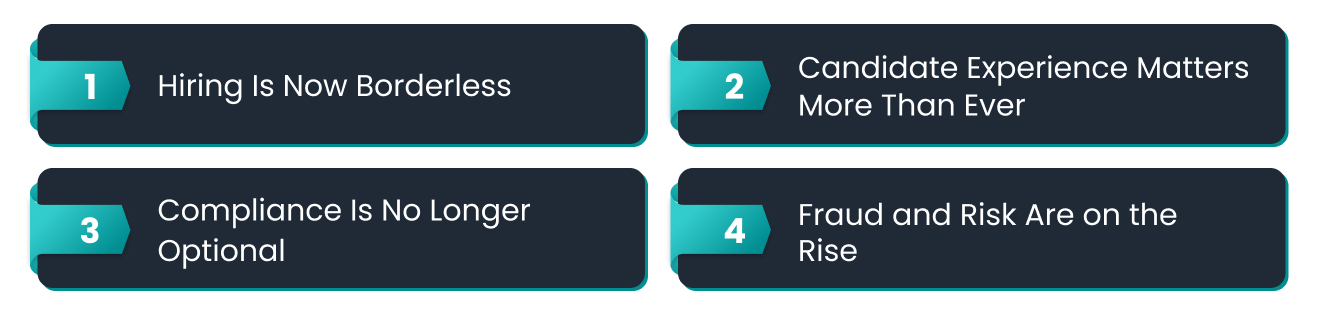
1. Hiring Is Now Borderless
Remote and hybrid work have erased location boundaries. You could hire a developer in Indore, a sales executive in Kochi, or a gig worker in Gurugram — all without a single in-person interaction.
That flexibility is powerful, but it comes with a question: How do you verify and onboard people you never meet physically?
A scalable verification infrastructure ensures that every new hire — anywhere in India — goes through a consistent, verifiable process.
2. Candidate Experience Matters More Than Ever
Verification has traditionally been the most painful part of onboarding. Endless document requests, delayed start dates, awkward follow-ups.
But modern HR teams know that a candidate’s onboarding experience shapes their perception of the company.
With digital verification services, candidates can give consent, upload documents, and complete verification within minutes — improving experience while maintaining compliance.
3. Compliance Is No Longer Optional
India’s DPDP Act (Digital Personal Data Protection Act) has redefined how organizations must handle employee data.
Every document shared over email, every spreadsheet with personal information — all of it now falls under privacy regulation.
Traditional verification methods — where employee data is emailed between HR teams, agencies, and ex-employers — are no longer compliant.
Verification-as-a-Service offers a way forward: consent-based, privacy-safe, auditable verification processes that align with modern data protection laws.
4. Fraud and Risk Are on the Rise
Fake degrees, forged documents, and impersonations are no longer rare — they’re organized and digital.
HR leaders can’t rely on manual verification or personal references anymore.
Automated verification infrastructure minimizes this risk by checking data against authoritative sources — such as government databases, verified employment records, and education boards — in real time.
Trust, once an assumption, now needs to be verified.
From Background Checks to Trust Infrastructure
Most HR teams think of verification as a “step” in onboarding.
VaaS changes that.
It turns verification into an always-on infrastructure — not just for pre-employment checks, but for every moment of the employee lifecycle.
Here’s how this shift looks in practice:
| Traditional Approach | Verification-as-a-Service Approach |
| Manual document collection and emails | Digital consent-based verification via APIs |
| Verification takes 5–15 days | Instant or near-real-time checks |
| Candidate frustration during onboarding | Smooth, transparent candidate experience |
| Limited compliance tracking | Complete audit trail and DPDP readiness |
| One-time verification | Continuous trust validation (during rehire, transfer, contract renewal) |
When verification becomes infrastructure, HR doesn’t just verify — it builds trust as a core capability.
The HR Impact: Speed, Compliance, and Confidence
Faster Hiring, Lower Drop-offs
With API-driven verification, HR teams can complete background checks in hours — not weeks. That directly reduces drop-offs, accelerates offer-to-join ratios, and improves hiring efficiency.
Simplified Workflows
No more juggling vendors or email chains. A unified verification layer connects multiple checks — identity, education, employment — through one dashboard or API.
Privacy by Design
Every verification happens with digital consent and minimal data exposure. That’s the foundation of DPDP compliance — protecting both the organization and the individual.
Consistency Across Roles
Whether you’re onboarding a full-time employee or a contract worker, the verification process remains consistent and auditable.
Real-World Scenarios Where HR Can Lead with Trust
1. Scaling Fast Without Breaking Trust
A startup growing from 50 to 500 employees in a year can’t afford manual verification chaos.
With Verification-as-a-Service, HR leaders can onboard at speed — ensuring every new hire is verified, compliant, and ready to work.
2. Gig and Contract Workforce
For platforms managing thousands of delivery executives, sales agents, or customer support staff — verification is ongoing. VaaS makes it possible to verify at scale while maintaining compliance and fairness.
3. BFSI and Regulated Sectors
For banks, NBFCs, and insurance firms, every hire represents regulatory responsibility. Automated verification ensures compliance with KYC norms and internal audit standards.
4. Education and Healthcare
Where trust and credentials directly affect outcomes, digital verification ensures authenticity — whether it’s a teacher’s certification or a medical professional’s license.
Humanizing Verification: The New Role of HR
The future of verification isn’t about replacing humans — it’s about freeing them.
When verification becomes a service, HR teams can shift from paperwork and follow-ups to what truly matters: people, culture, and experience.
Imagine:
- An HR operations manager tracking every candidate’s verification status in real time.
- A new joiner getting instant updates on their verification progress, with full transparency.
- An HR head is confident that every hire is verified, every document compliant, every process audit-ready.
That’s what a “trust infrastructure” looks like in HR.
It’s not cold automation. It’s human trust, powered by digital certainty.
Beyond Verification: Building a Trust Network
Here’s the most exciting part — once verification becomes digital and standardized, trust becomes portable.
That means a verified employment record, once issued, can move with the employee to their next opportunity.
No redundant background checks. No repeated document submissions. No loss of trust in transition.
This is how the workforce economy evolves — from isolated verifications to a connected trust network.
It’s not a distant dream. India has already done it once with UPI — by making payments interoperable and portable. The same can happen with verification.
A trust layer for employment, where verified credentials travel securely across employers.
The Future of Verification as a Service in HR
Let’s peek ahead.
1. Continuous Verification
Periodic checks — for compliance, rehires, or role changes — will become automated and consent-driven.
2. AI and Fraud Detection
AI will help detect forged documents, deepfakes, and suspicious data anomalies before they cause damage.
3. Portable Employee Records
Verified credentials — employment, education, ID — will be issued as reusable, portable credentials that belong to the employee.
4. Seamless Integration
Verification will be embedded into HRMS, ATS, and onboarding tools — invisible but always active.
5. DPDP-First Verification
Privacy, consent, and data minimization will become default settings, not compliance afterthoughts.
A Mindset Shift for HR Leaders
The most forward-looking HR teams aren’t asking “How do we verify faster?”
They’re asking “How do we build trust at scale?”
That’s the real shift Verification-as-a-Service brings.
It’s not just a new tool — it’s a new philosophy.
It says:
- Every verified record strengthens your brand.
- Every compliant process protects your people.
- Every digital consent builds transparency.
When trust becomes infrastructure, HR becomes the architect of it.
Closing Thought: Trust Is the New Productivity
Speed is important. Compliance is critical. But in the long run, trust is what drives both.
In the workforce economy, where employees, contractors, and gig workers flow between organizations, trust will be the most valuable currency.
Verification-as-a-Service is not just about verifying identities. It’s about verifying trust — instantly, digitally, and ethically.
HR leaders who understand that aren’t just adapting to change.
They’re building the foundation for a more trusted, transparent, and human future of work.



Leave a Reply