
Table of Contents
ToggleTrust in India has always been deeply personal. For decades, a kirana owner hired staff because a neighbour vouched for them. A family chose a domestic help based on word-of-mouth from the colony. Even large businesses leaned heavily on personal networks and references. Formal verification was rare, expensive, and considered necessary only in the highest corporate or government circles.
That world is disappearing fast.
India’s economy has leapfrogged in scale and digitisation. Platforms onboard millions of gig workers; enterprises hire in bulk across multiple states; SMEs engage contractors and delivery agents they may never have met in person. At the same time, fraud, impersonation, and data-driven scams are on the rise. Informal trust signals can no longer keep up.
The result: Background checks are not just creeping outward from corporates to kiranas — they are transforming into a new infrastructure of trust that underpins the entire economy.
The Cultural Shift: From Word-of-Mouth to Verified Proof
Historically, Indians relied on social capital to vouch for someone’s integrity. A landlord asked for a guarantor, an employer asked a friend for references, and a shopkeeper trusted a local family name.
But as workforces become mobile and transactional, geography and family networks no longer offer reliable assurance. A delivery partner in Bengaluru might come from a small town in Uttar Pradesh. A freelancer in Delhi may work for a startup in Pune. Connections are thinner. Verification steps in as a replacement for community trust — scalable, neutral, and digital.
Why Verification Became Mainstream
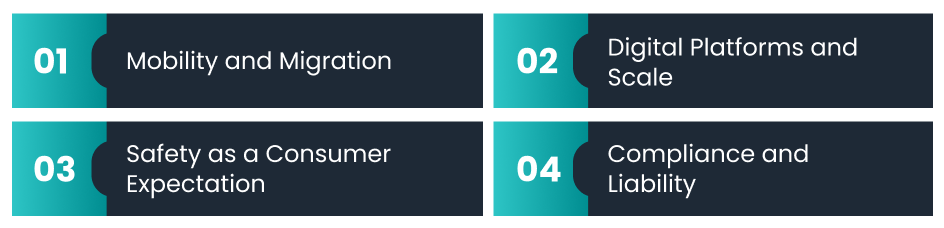
Mobility and Migration
With millions of workers moving across states for opportunities, traditional local endorsements have lost their value. Employers need verifiable, cross-border checks.
Digital Platforms and Scale
Platforms like e-commerce, ride-hailing, and food delivery have normalised the idea that strangers interact daily. This requires institutional trust, not personal trust.
Safety as a Consumer Expectation
A customer now expects the cab driver or technician visiting their home to be vetted. Safety is no longer optional — it’s a brand promise.
Compliance and Liability
If an incident occurs, regulators, media, and customers all ask the same question: “Did the company do its due diligence?” This forces businesses of every size to adopt verification.
Case Studies of Everyday Verification
- The Domestic Worker App: Families hiring house helps now often insist on police verification through digital apps. This was unimaginable even 10 years ago.
- The Franchise Owner: A fast-food franchise operator in Tier-2 India insists on Aadhaar-based checks for all delivery boys because one theft incident hurt sales.
- The Healthcare Startup: Nurses and attendants are not onboarded without license and credential verification, because patient safety is paramount.
- The MSME Exporter: A textile supplier verifies all temporary contract staff before granting access to warehouses, since global buyers demand compliance.
These examples illustrate that background checks are no longer about “big corporations covering legal bases.” They are about protecting everyday trust transactions.
The Human Angle: What Verification Means to Workers
Verification is not only about employers. For workers, a verified identity can be an asset:
- A delivery agent with a clean verified record may get priority gigs.
- A nurse with verified credentials can access better-paying hospitals.
- A freelancer with verified employment history signals trust to global clients.
In other words, verification becomes a passport to opportunity. Just as credit scores opened access to finance, background checks open access to jobs.
India’s Informal Economy Meets Digital Verification
Over 80% of India’s workforce is still informal. But platforms and SMEs are bringing them into the formal trust net by requiring verification. This convergence has three effects:
Raising Standards
Even small shops realise they need trustworthy staff, pushing verification adoption downward.
Democratising Access
Affordable, API-driven checks mean kiranas can now access services once reserved for corporates.
Creating a Trust Dividend
Workers who pass checks become more mobile and employable across geographies and industries.
The Next Leap: Continuous and Portable Trust
The future of background checks isn’t just one-time screening. It’s about continuous and portable trust.
- Continuous Monitoring: Employers and platforms will get alerts if a worker’s record changes (e.g., new criminal record, expired license).
- Portable Credentials: A worker may carry verified credentials across jobs — like a “trust wallet” — so they don’t need to start from zero each time.
- Privacy by Design: Workers will selectively disclose what’s necessary (e.g., age verified instead of sharing full date of birth).
This evolution shifts verification from a burden to an ecosystem enabler.
Beyond Hiring: Expanding the Scope of BGV in India
The ripple effects of background checks go far beyond jobs:
Tenant Screening → Landlords increasingly want verified tenants to reduce defaults and disputes.
Vendor Due Diligence → Corporates verify supplier credibility before signing contracts.
Community Safety → Resident Welfare Associations run checks for security guards, drivers, and domestic staff.
Digital Platforms → EdTech, logistic, and dating platforms use verification to prevent misuse and fraud.
Everywhere strangers interact, verification is the glue of trust.
Challenges Ahead
Affordability for Small Players: A kirana may hesitate to pay for checks unless solutions are ultra-low-cost.
Speed vs Depth: A gig platform cannot afford week-long checks; speed must coexist with accuracy.
Privacy Concerns: With India’s DPDP Act, consent-based flows and minimal data retention become crucial.
Inclusion: Many workers still lack formal documents; verification systems must accept alternate proofs without exclusion.
Conclusion: The New Trust Economy
India is moving from a society of personal trust networks to a trust infrastructure powered by data, APIs, and continuous verification. Whether it’s a delivery rider, a nurse, a tenant, or a corporate hire — the expectation is the same: prove you are who you say you are, and prove you can be trusted.
This is no longer the preserve of corporates. From streetcorner shops to skyscraper boardrooms, verification has become a shared cultural norm. It protects businesses, empowers workers, reassures customers, and strengthens society.
The companies that understand this shift early — and design verification processes that are fast, inclusive, and privacy-respecting — won’t just avoid risk. They will win in the marketplace of trust.





Leave a Reply