
Table of Contents
ToggleWhen parents entrust their kids to college or school, they put an immense amount of trust in the institution. They do not only hope that the kids will be taught, but they also hope that they will be safe, directed, and treated honorably. To the institution, this trust is a privilege and an overwhelming responsibility.
Still, despite this understanding, background check continues to be a neglected aspect of hiring and operations in schools. From a teacher to a transport driver, a laboratory assistant to a visiting consultant—each individual within the ecosystem comes into contact with vulnerable groups and sensitive environments. In an environment that determines lives and futures, there can be no compromise on safety and trust.
Today’s modern schools, universities, edtech providers, and training schools are coming to realize that background checks are not merely an administrative nicety. It’s a requirement.
Below are five of the most essential reasons why background verification is important in the education sector nowadays.
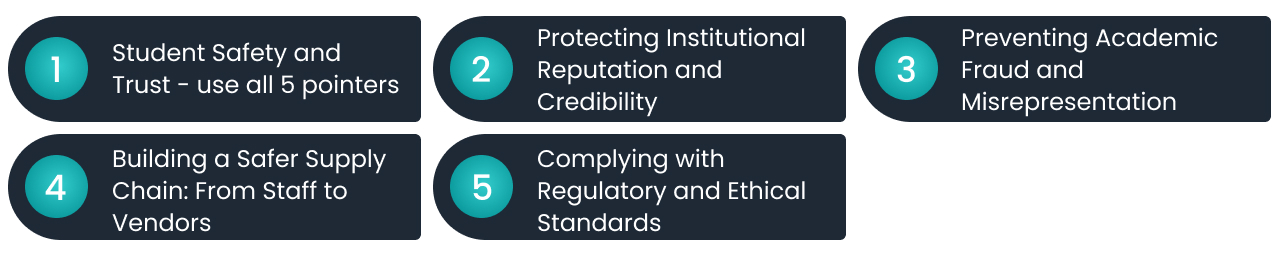
1. Student Safety and Trust
Safety is not negotiable in schools. All staff—academic, administrative, or contractual—interact directly or indirectly with students. One failure in hiring would risk the lives of hundreds and irreversibly harm an institution’s reputation.
There have been several incidents in recent times where poor screening resulted in the hiring of people with criminal backgrounds or dubious conduct records. These incidents not only posed threats to students but also generated national debate on school accountability.
Background screening is the initial line of defense against such risks. It provides institutions with the opportunity to identify any red flags within an individual’s background before they enter the system.
For example:
- Criminal record checks ensure that individuals with histories of violence, abuse, or financial fraud are not hired.
- Address verification confirms the authenticity of residence details, which becomes crucial when law enforcement needs to trace records.
- Identity verification validates that the person joining the institution is who they claim to be—critical in an era of fake IDs and impersonation.
By institutionalizing background checks, schools and universities send a clear message to parents: that safety is embedded in their culture, not added as an afterthought.
2. Protecting Institutional Reputation and Credibility
Reputation is everything in education. A single controversy can overshadow years of excellence. Parents and students make decisions based on trust—trust that the institution is credible, transparent, and ethically sound.
Hiring without verification can undo that in an instant. Imagine a school learning months later that a senior teacher had submitted a fake degree or that a college’s administrative head had been involved in financial misconduct elsewhere. The damage to brand reputation would be immediate and lasting.
Comprehensive background verification protects against such scenarios. It helps verify:
- Educational credentials – ensuring teachers and staff have genuine qualifications.
- Employment history – confirming that previous experience and references are authentic.
- Reference checks – providing a glimpse into a candidate’s work ethic, behavior, and interpersonal conduct.
These checks aren’t just about filtering out bad hires—they’re about upholding the institution’s promise to students, parents, and the larger community.
Moreover, institutions that actively showcase their commitment to verified hiring practices tend to attract higher trust from both parents and prospective employees. It becomes a differentiator—a visible proof of integrity.
3. Preventing Academic Fraud and Misrepresentation
Fake degrees and forged documents are more common than most realize. A 2023 industry report estimated that nearly 10–15% of resumes in India contain some form of misrepresentation, often around education and experience.
For the education industry, the irony is particularly sharp. How can an institution that stands for learning employ individuals who falsify their own qualifications?
A well-structured background verification process ensures that every credential claimed by a candidate—whether it’s a B.Ed, M.Sc, or Ph.D.—is legitimate and issued by an accredited institution. Verification services like education record verification directly validate details with universities or boards, eliminating reliance on photocopies or unverified submissions.
In edtech and tutoring platforms, this becomes even more crucial. With digital classes and one-on-one virtual learning sessions, students and parents often don’t meet teachers in person. Verified educator profiles not only prevent fraud but also build credibility and comfort in online environments.
Institutions that make “verified credentials” a part of their hiring badge effectively raise the standard for accountability in the sector.
4. Building a Safer Supply Chain: From Staff to Vendors
An educational ecosystem isn’t just made up of teachers and administrators. There are transport vendors, hostel staff, canteen workers, security guards, maintenance teams, and digital contractors—all of whom interact with students and faculty daily.
Neglecting background verification for outsourced or third-party staff can lead to serious vulnerabilities. Transport providers, for instance, are often entrusted with the safety of children for hours each day. Hostel wardens and housekeeping staff have direct access to living spaces. A single oversight can have devastating consequences.
Comprehensive verification should therefore extend to all categories of personnel:
- Criminal record and police verification for support staff.
- Driver’s license and traffic record verification for transport personnel.
- Address and ID checks for vendors and temporary workers.
Institutions that apply uniform verification policies—irrespective of employment type—create a safer and more accountable ecosystem. They also reduce liability risks and demonstrate a clear commitment to responsible governance.
5. Complying with Regulatory and Ethical Standards
Regulatory expectations in the education sector are evolving fast. Various state education boards, CBSE, and university councils have begun emphasizing stricter hiring and verification norms for teaching and non-teaching staff.
For example, many state governments in India have issued advisories mandating police verification of school employees and character certificates as part of recruitment. Edtech platforms are also under growing scrutiny to ensure verified educator identities and content authenticity.
Background verification aligns institutions with these compliance expectations. It establishes documented due diligence, proving that every hiring decision followed a structured and ethical process.
Beyond compliance, there’s an ethical imperative too. Education is a space that shapes young minds and influences values. Institutions have a moral responsibility to ensure that those guiding students uphold the same values they teach.
When a school or university invests in systematic verification, it’s not just protecting itself—it’s reinforcing the foundation of trust that education rests upon.
The Future of Safe and Transparent Education
The education landscape is changing. Hybrid classrooms, remote teaching, and the rise of digital learning platforms have blurred geographical boundaries. With opportunity comes new challenges around identity, authenticity, and accountability.
As technology continues to integrate into education, so should trust infrastructure. Modern verification solutions like instant background checks, digital ID verification, and real-time criminal record databases make it possible to verify credentials within minutes rather than weeks.
Platforms like OnGrid are helping institutions achieve exactly that—combining reliability, scale, and speed. From pre-employment checks to ongoing re-verification cycles, institutions can now maintain a living record of trust across their entire ecosystem.
Ultimately, background verification is not about suspicion—it’s about assurance. It ensures that teachers are qualified, staff are trustworthy, and every stakeholder feels safe and respected within the institution’s ecosystem.
When education is built on verified trust, learning truly thrives.
Conclusion
The education industry carries an unparalleled responsibility—to educate, to nurture, and to protect. In this mission, background verification is not an optional step. It’s a cornerstone of accountability and care.
Whether it’s about preventing fraud, protecting students, or maintaining a respected institutional identity, verification ensures that safety and integrity are part of the institution’s DNA.
Trust, after all, begins with verification—and that’s where a reliable partner like OnGrid helps the education sector stay ahead, stay safe, and stay trusted.




Leave a Reply