
A few years ago, background verification was seen as a routine HR activity — something you did after rolling out the offer letter. But 2025 looks very different.
The Digital Personal Data Protection (DPDP) Act, hybrid work models, and the rise of the gig economy have completely changed how companies verify and manage workforce data. Today, background verification in India isn’t just about reducing risk — it’s about building a culture of trust, compliance, and transparency.
That’s why choosing the right background verification vendor is a strategic decision, not a procurement task. The vendor you select will be handling your candidates’ most sensitive personal data — and, by extension, representing your brand’s values.
Before you finalize a partner, here are 10 crucial questions every employer should ask to ensure your verification process is ethical, compliant, and future-ready.
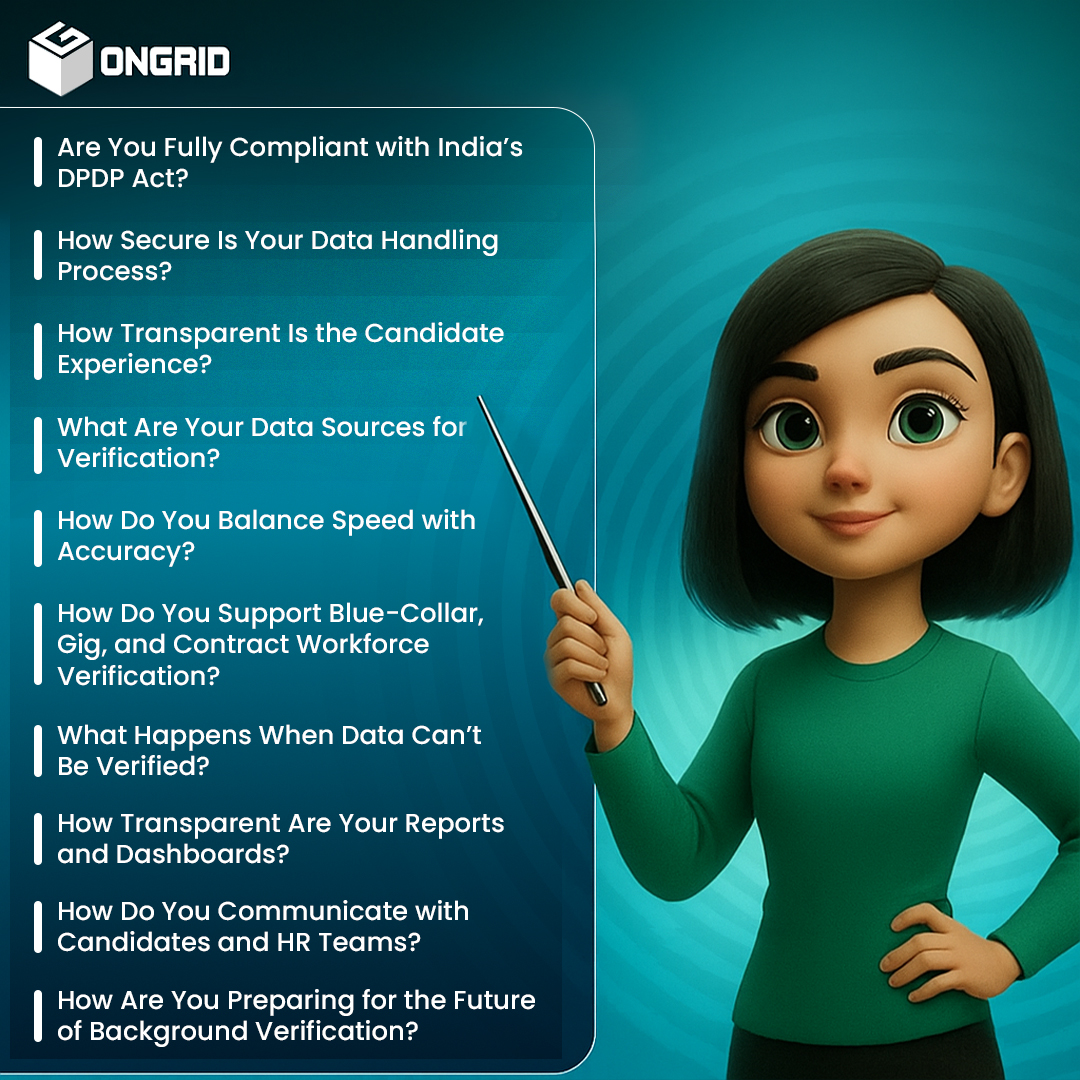
1. Are You Fully Compliant with India’s DPDP Act?
This is the first and most essential question in 2025.
The DPDP Act places clear obligations on how personal data — including identity, address, and employment details — is collected, processed, and stored. As an employer, you’re accountable for the practices of your background verification vendor as well.
Ask them:
- How do you collect and store candidate consent?
- Can candidates access or correct their data?
- Is the data deleted once verification is complete?
A truly compliant employee screening partner will have transparent consent flows, audit logs, and deletion policies. Anything less could expose your organization to compliance and reputational risks.
2. How Secure Is Your Data Handling Process?
Every background check involves confidential data — from Passport and PAN details to employment history and address proofs.
Before you share candidate information, ask your vendor:
- How is this data protected in storage and transit?
- Do you use encryption and access control?
- Are you certified under ISO 27001 or SOC 2 standards?
In an era where data breaches can destroy trust overnight, data security in background verification isn’t a technical detail — it’s a business necessity.
3. How Transparent Is the Candidate Experience?
Your brand’s first impression on a new hire often begins during background verification.
A responsible vendor ensures the process is transparent and respectful — not confusing or invasive.
Ask:
- How is candidate consent obtained?
- Do candidates receive updates or progress notifications?
- How are disputes or incorrect data handled?
A candidate-friendly background verification process improves trust, reduces anxiety, and enhances your employer brand.
4. What Are Your Data Sources for Verification?
Not all verifications are created equal. The credibility of a background check depends entirely on where the information comes from.
Ask your vendor:
- Are your verifications conducted through authoritative and official sources (universities, registries, government databases)?
- How do you verify older or offline records?
- How often do you refresh and validate your databases?
Reliable background verification companies in India will be transparent about their data sources. Any vendor that can’t explain their verification network clearly might be relying on manual or unofficial methods — a risk you shouldn’t take.
5. How Do You Balance Speed with Accuracy?
Fast results are important — especially in high-volume hiring — but accuracy should never be compromised.
Ask your vendor:
- What’s your average turnaround time (TAT) for different checks?
- How do you handle incomplete or unverifiable data?
- How do you categorize and report discrepancies?
Good vendors balance technology with quality control — using automation to reduce delays, but maintaining human oversight where judgment matters.
In 2025, smart verification means being both fast and factual.
6. How Do You Support Blue-Collar, Gig, and Contract Workforce Verification?
India’s workforce today is more distributed than ever — from delivery partners and warehouse staff to contract employees and freelancers.
Traditional BGV systems designed for corporate roles often fail this diversity.
Ask:
- Can you verify individuals with limited documentation?
- Do you operate effectively across tier-2 and tier-3 cities?
- Do you provide multilingual communication and consent?
A robust employee verification partner should help you bring all segments — white-collar or frontline — under one compliant framework.
7. What Happens When Data Can’t Be Verified?
This is where many vendors falter.
Sometimes, a previous employer has shut down, or a university doesn’t respond — leaving “unverified” gaps in the report.
Ask your vendor:
- How do you treat unverifiable cases?
- Do you provide context or alternate verification routes?
- How do you handle escalations?
An ethical background verification company will aim to clarify, not penalize. They’ll provide detailed reasoning and support re-verification — not just stamp the report “negative.”
8. How Transparent Are Your Reports and Dashboards?
Modern HR and compliance teams need real-time visibility into verification progress — not endless email threads or delayed reports.
Ask:
- Do you provide a live dashboard to track candidate verification?
- Can I view pending, completed, and flagged cases in one place?
- How clearly are discrepancies defined and categorized?
A transparent reporting system not only saves time but also strengthens internal accountability. You should never have to “follow up” to know the status of your checks.
9. How Do You Communicate with Candidates and HR Teams?
Poor communication creates confusion for everyone — candidates, recruiters, and compliance officers alike.
Ask:
- How do you notify candidates about missing documents or delays?
- What communication channels do you use (email, WhatsApp, call)?
- How quickly can HR teams reach your support team?
A reliable background verification vendor in India values communication as much as accuracy. They keep both HR and candidates informed at every stage.
10. How Are You Preparing for the Future of Background Verification?
The background verification industry is evolving fast. AI is improving document checks, new privacy regulations are emerging, and digital identity systems are expanding.
Ask your vendor:
- How are you staying ahead of regulatory changes?
- What improvements are you investing in — accuracy, automation, or compliance?
- How do you see background verification in India evolving in the next few years?
A future-ready partner doesn’t just deliver reports — they help your organization adapt to new norms of trust and transparency.
Bonus Question: How Do You Measure Quality and Accountability?
Verification isn’t just about data collection — it’s about responsibility.
Ask:
- What quality assurance checks do you run internally?
- What SLAs or error thresholds do you maintain?
- How often do you audit your processes?
The best employee background check vendors hold themselves accountable for accuracy and ethical standards — not just timelin
Conclusion: Choose Trust, Not Just Turnaround Time
The best background check company for your organization isn’t the one that offers the lowest cost or fastest report. It’s the one that treats your candidate data with integrity, complies with privacy laws, and values transparency.
In 2025, BGV is no longer a back-office task — it’s part of your employer reputation and risk management framework.
So before signing with any vendor, ask these 10 questions — and listen carefully not just to what they say, but how confidently and clearly they say it.
Because in the end, background verification isn’t just about who your candidates were — it’s about the kind of company you are.





Leave a Reply