
Table of Contents
ToggleRenewable energy projects are often spoken about in the language of optimism—clean power, sustainability goals, climate commitments, and future-ready infrastructure. But anyone who has actually worked on a solar park, wind farm, green hydrogen unit, or transmission-heavy renewable rollout knows the truth: behind every megawatt installed is a long, complex web of vendors, contractors, suppliers, and partners.
And this is where things get real.
A delayed inverter shipment can stall commissioning by weeks. A non-compliant EPC partner can expose the project to regulatory scrutiny. A financially weak subcontractor can abandon a site midway. In renewable energy, vendor risk isn’t a back-office problem—it’s a project risk.
That’s why vendor due diligence in renewable energy can no longer be treated as a checklist exercise. It demands a new standard—one that matches the scale, speed, and sensitivity of the sector itself.
Renewable Energy Is Different – And So Are Its Risks
Unlike conventional infrastructure, renewable energy projects operate under a unique mix of pressures:
- Tight regulatory timelines
- Multi-state or cross-border operations
- Heavy dependence on government incentives and compliance
- Large capital outlays with thin margins
- A long tail of vendors, many of whom are small, regional, or first-time players
A single utility-scale project can involve hundreds of third parties—EPCs, logistics partners, O&M vendors, land aggregators, manpower contractors, equipment suppliers, consultants, and local service providers.
Each one becomes a risk surface.
Traditional vendor onboarding models were built for slower, centralized industries. Renewable energy doesn’t have that luxury. Projects are fast, distributed, and often executed in parallel across multiple locations.
Which means the old way of doing due diligence—manual checks, fragmented data, and inconsistent standards—simply doesn’t hold up anymore.
The Illusion of “Basic Checks”
Many organizations still rely on what they consider “basic due diligence”:
- PAN and GST verification
- A few documents shared over email
- Self-declared compliance statements
- Manual background checks done once, then forgotten
On paper, this looks sufficient. In reality, it creates blind spots.
What happens when:
- The GST is valid, but filings are irregular?
- The company exists, but directors are linked to failed entities?
- The vendor passed checks two years ago but is now financially stressed?
- Multiple teams onboard the same vendor with different data sets?
These gaps don’t show up immediately. They surface later—as delays, disputes, compliance notices, or worse, project shutdowns.
Vendor due diligence in renewable energy has to move beyond identity verification. It needs to understand capability, continuity, and credibility.
Scale Changes Everything
Renewable energy companies don’t scale linearly. They scale in bursts—new parks, new states, new technologies, new policy windows.
When scale increases, two things usually happen:
- Vendor volume explodes
- Manual processes break
Procurement teams get overloaded. Risk teams become reactive. Operations teams start bypassing controls to meet deadlines.
This is where inconsistency creeps in:
- Different teams running different checks
- Duplicate vendor records
- Incomplete or outdated information
- Decisions made on partial visibility
The irony? Most organizations don’t realize how much risk they’re carrying—until something goes wrong.
A modern due diligence approach accepts one truth: speed and scrutiny must coexist. You can’t sacrifice one for the other anymore.
Financial Health Is Operational Risk
In renewable energy, a vendor’s financial stability directly impacts execution.
A contractor under financial stress may:
- Delay material procurement
- Cut corners on quality or safety
- Struggle to pay workers, leading to site disruptions
- Abandon the project altogether
Yet financial due diligence is often limited to surface-level checks.
What’s really needed is context:
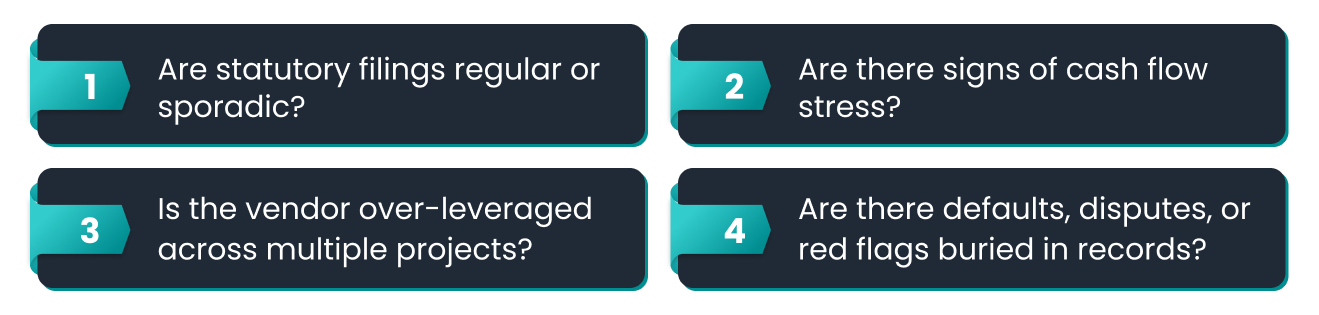
These aren’t “finance team problems.” They’re project risks disguised as numbers.
Vendor due diligence in renewable energy must treat financial insight as an early warning system—not a compliance formality.
Compliance Isn’t Binary Anymore
It’s easy to think of compliance as pass/fail. Either a vendor is compliant, or they’re not.
Reality is messier.
Compliance today sits on a spectrum:
- Partially compliant vendors
- Vendors compliant in one state but not another
- Vendors compliant on paper but weak on execution
- Vendors who were compliant once, but haven’t kept up
Renewable energy projects often span jurisdictions, each with its own labor laws, tax requirements, environmental norms, and reporting standards.
Due diligence needs to be continuous, not static.
A vendor cleared at onboarding shouldn’t become invisible afterward. Risk evolves. And due diligence has to evolve with it.
Reputation Risk Travels Fast
Renewable energy brands operate under public scrutiny—investors, governments, communities, and global partners are watching.
One vendor-related issue can ripple outward:
- Legal disputes
- Labor violations
- Environmental non-compliance
- Negative media coverage
And in today’s connected world, reputation damage doesn’t stay local.
This is why reputation and integrity checks matter—not as a one-time scan, but as an ongoing lens. Court records, sanctions, adverse media, and regulatory actions provide context that raw documents never will.
Ignoring this layer is no longer an option.
Operational Reality Matters as Much as Documents
One of the biggest gaps in traditional due diligence is the assumption that documents tell the full story.
They don’t.
A vendor can be legally registered, financially compliant, and still operationally weak:
- No real site presence
- Inflated capacity claims
- Weak management oversight
- Poor execution history
In renewable energy, execution quality is everything. Missed deadlines don’t just affect one project—they cascade across power purchase agreements, grid connectivity, and revenue timelines.
Modern vendor due diligence needs to answer a simple question: Can this partner actually deliver what they’re promising?
That requires looking beyond paperwork into operational reality.
A Quiet Shift Is Already Happening
Across the industry, leading renewable energy players are rethinking how they approach third-party risk.
Not loudly. Not with big announcements.
But quietly:
- Standardizing checks across teams
- Reducing manual data handling
- Creating single sources of truth for vendor data
- Bringing structure to risk assessment without slowing down onboarding
The focus is shifting from “Did we do the check?” to “Do we truly understand who we’re working with?”
That mindset shift is the real transformation.
The Future of Vendor Due Diligence in Renewable Energy
The next phase of renewable energy growth will be defined by execution excellence, not ambition alone.
As projects get larger and timelines tighter, organizations will need:
- Faster onboarding without cutting corners
- Deeper risk visibility without adding bureaucracy
- Consistency across teams, regions, and partners
- Ongoing monitoring instead of one-time approvals
Vendor due diligence in renewable energy is no longer about protection alone. It’s about enabling scale responsibly.
Those who treat it as a strategic capability—not a compliance obligation—will build projects that last, partnerships that hold, and growth that doesn’t collapse under its own weight.
Clean energy may power the future, but it’s built by people, processes, and partners today.
And the strength of any renewable energy project is only as strong as the weakest link in its vendor ecosystem.
Raising the standard of vendor due diligence isn’t about distrust.
It’s about clarity.
It’s about foresight.
And ultimately, it’s about building renewable infrastructure that’s as resilient as the future it promises.






Leave a Reply