
Table of Contents
ToggleIntroduction: A Changing Workforce Paradigm
India’s workforce is changing. The 9-to-5 office grind, which was the prevailing model a few years ago, is giving way to telecommuting jobs, freelancer projects, and variable gig work. Concurrently, most professionals have begun embracing two or more jobs in order to augment their earnings, a trend today widely referred to as moonlighting.
For the employees, it means opportunities for extra income and varied experience. But for employers, it poses a dilemma: how do you guarantee that your new employee is fully dedicated, truthful in their work history, and not clandestinely employed elsewhere simultaneously?
This is where UAN checks—a social security system-linked verification method—have started to make all the difference. Employers in IT, fintech, e-commerce, and gig platforms are increasingly using UAN-based checks to ensure transparency and trust in the hiring process.
What is a UAN Check, Exactly?
Each salaried worker paying into the Employees’ Provident Fund (EPF) of India is allocated a Universal Account Number (UAN) by the Employees’ Provident Fund Organisation (EPFO). This number doesn’t change even if a person keeps switching jobs.
A UAN verification entails checking the UAN of an individual with the EPFO records to confirm their work history, contribution record, and continuity. As opposed to a regular résumé verification or a reference call, a UAN verification is done from official sources, hence giving room for little fudging.
For the employers, it simply translates to this: authenticity at scale.
Imagine a scenario.
A medium-sized IT firm recruited a developer for an important project. On paper, the candidate was ideal—strong resume, positive referrals, and excellent interview performance. After a few months, however, the firm saw delayed deadlines and split attention. Subsequently, it was discovered that the developer was moonlighting for another company on a remote basis.
This is not a one-off. The ubiquity of remote and hybrid work arrangements has made moonlighting a piece of cake. Employers are now concerned with:
- Conflicts of interest when their workers labor for competitors.
- Decrease in productivity when focus is divided among various jobs.
- Security risks to data as sensitive company data could be mismanaged.
Conventional verification procedures seldom pick up on such moonlighting. However, with UAN checks, employers are in a position to immediately determine whether a candidate has dual contributions with various employers, providing an immediate means of detecting moonlighting.
The Broader Use of UAN Checks
While addressing moonlighting is a front-page advantage, UAN checks have several other uses that account for their growing popularity.
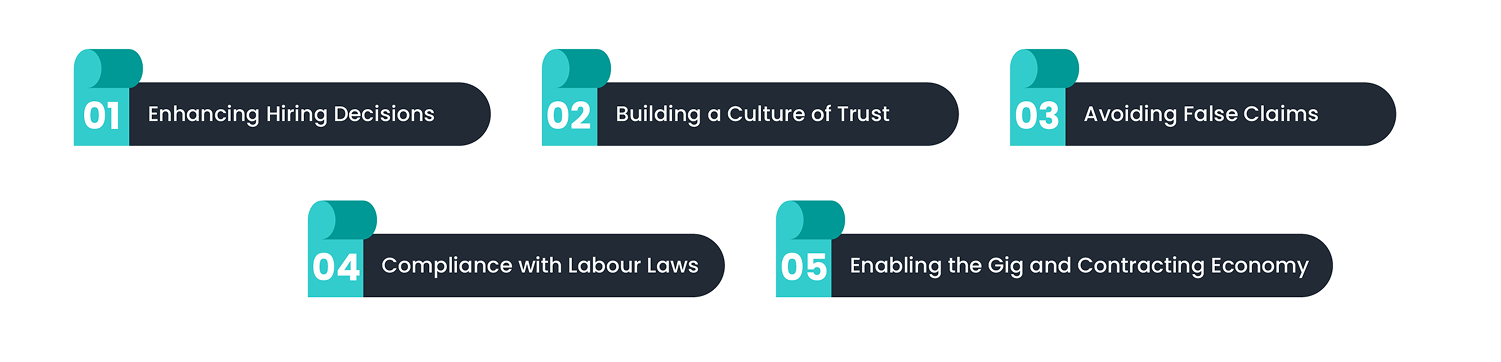
1. Enhancing Hiring Decisions
Traditional background checks tend to have holes. Job titles can be exaggerated, tenure dates stretched out, or short time gaps omitted in an attempt to appear more impressive. A UAN verification, however, draws from EPF contribution records, revealing employers the true employment timeline. This openness enables hiring managers to compare the candidate’s tale with official records.
2. Building a Culture of Trust
Trust has emerged as a business competitive edge in the workplace. When employers freely depend on proven facts, and applicants understand that their information will be checked, it fosters an environment of truthfulness. With the passage of time, this practice diminishes deception and enhances transparency in the hiring process.
3. Avoiding False Claims
Misrepresentation in employment resumes is nothing new. Applicants also tend to state experience in firms that they have never worked in, or inflate their years of service to cover gaps. Fake offer letters too float around in the marketplace at times. UAN verification brings out such contradictions by comparing a person’s assertion with EPFO contributions, leaving little scope for imagination.
4. Compliance with Labour Laws
As India’s labor codes become more stringent, employers are compelled to have clean and compliant hiring processes. By verifying EPF contributions through UAN checks, organizations can demonstrate to auditors and regulators that they adhere to due diligence in recruitment and workforce management.
5. Enabling the Gig and Contracting Economy
India’s gig economy—from delivery partners to digital freelancers—grows at breakneck rates. For companies onboarding hundreds of short-term employees, background checks are an aggravation. UAN checks offer a scalable solution where even gig and contract employees are screened against official records.
Why Employers Prefer UAN Checks Over Other Methods
Employers have traditionally used background verification agencies, reference calls, and document collection. But these methods have their limitations:
- References may be biased or forged.
- Documents may be tampered with.
- Manual verification is laborious.
In nutshell, UAN checks provide:
- Speed: Verification is faster since it leverages pre-existing EPFO records.
- Accuracy: Information is sourced from an official, centralized database.
- Scalability: Employers can verify thousands of employees with ease.
- Cost-effectiveness: Automated verification eliminates manual overhead.
For businesses growing quickly—such as startups, IT companies, and gig platforms—this combination of speed, accuracy, and affordability makes UAN checks a no-brainer.
Addressing Candidate Concerns: Privacy and Transparency
Some candidates worry that UAN checks may intrude on their privacy. After all, EPFO records contain sensitive details about contributions and employment.
This is where responsible practices matter. Leading background verification providers ensure that:
- Consent is always taken before initiating a UAN check.
- Only relevant employment-related details are shared with the employer.
- Data is encrypted and protected to maintain confidentiality.
When well-explained, most applicants actually embrace UAN checks because they safeguard them from misrepresentation or misinterpretation during recruitment.
The Future of UAN-Based Verification
As India’s digital economy matures, UAN checks are set to grow in scope. Future developments could include:
- Integration with AI tools to automatically detect suspicious employment overlaps.
- Cross-verification with other government databases such as Aadhaar-linked employment schemes.
- Real-time dashboards for employers to track workforce transparency across geographies.
With the growth of distributed teams and remote hiring, all such integrations will become more valuable.
Final Thoughts
The Indian workplace is transforming rapidly. Remote work, side hustles, and gig work are providing professionals with more opportunities than ever before. But to employers, this flexibility also creates risks—moonlighting, false claims, and compliance gaps.
In this setting, UAN checks are becoming increasingly popular since they make hiring bring authenticity back. They enable firms to go beyond résumés and references, depending on confirmed employment information instead. Whether to detect dual employment, instill trust, or remain compliant, UAN checks are defining the future of background checking in India.
For organizations that seek to grow with confidence in this age of heightened competition, embracing UAN verification isn’t a good idea—it’s fast becoming a requirement.




Leave a Reply