
Table of Contents
ToggleWhen people talk about workplace culture, they often mention engagement, belonging, or even perks. But if you peel away the layers, what truly powers the employee experience is trust.
- Trust that the organization hires fairly.
- Trust that leaders will communicate transparently.
- Trust that hard work will be recognized.
- Trust that even in the exit stage, dignity is preserved.
In today’s hybrid, gig-driven, and borderless workforce, the stakes are even higher. Talent flows in and out faster than ever. Employees are virtually onboarded, often managed across time zones, and sometimes juggle multiple contracts. In such a disrupted world, trust isn’t linear—it’s continuous. It’s not a “check once and forget” process. It must be embedded across the entire lifecycle.
Let’s explore how trust is built (or broken) across four critical stages: pre-hiring, during hiring, post-hiring, and exit.
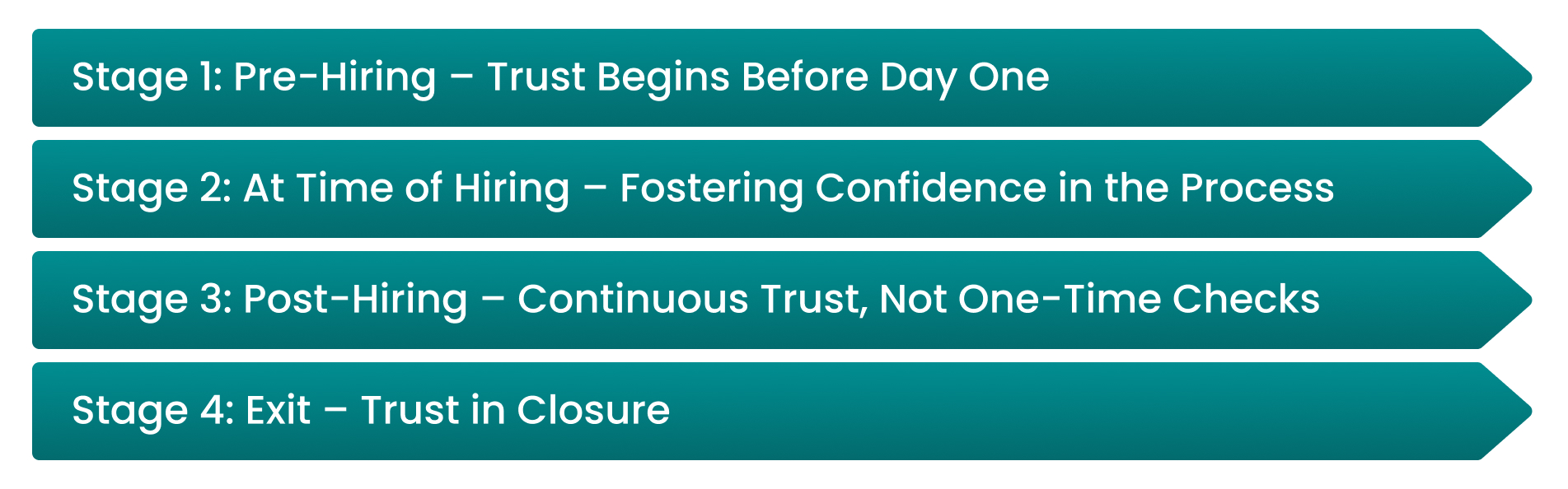
Stage 1: Pre-Hiring – Trust Begins Before Day One
Traditionally, verification happened after the offer. A candidate would be selected, and then HR would scramble to validate documents. But in an era of resume fraud, impersonation, and inflated claims, this reactive approach only delays trust.
Trust today must start early—before the offer is even extended.
Imagine an enthusiastic recruiter recommending a candidate. Later, verification reveals the candidate exaggerated previous roles or used fake salary slips. Now, HR faces an awkward rollback, the candidate feels humiliated, and the employer brand takes a hit. That’s trust broken—before the relationship even begins.
The intelligent approach? Switch from “offer → verify” to “verify → offer.” When inconsistencies are caught early, recruiters shortlist with confidence, hiring managers save rework, and candidates perceive the company as honest and serious about integrity.
How companies can integrate trust at pre-hiring:
- AI checks at the front of the funnel: AI-based parsing of resumes and salary slips, cross-verified against government data, and database screening.
- Identity verification prior to interviews: Liveness detection and facial identification confirm the individual presenting is the actual candidate—not a substitute.
- Clarity for applicants: Admit openly that verification is involved, indicating equity and consistency for everyone applying.
Trust at this point involves applicants and employers both knowing they’re entering an honest relationship.
Stage 2: At Time of Hiring – Fostering Confidence in the Process
Hiring isn’t merely hiring the right individual; it’s about fostering confidence that the process is equitable. For applicants, the query is: Am I being assessed openly? For business owners, it’s: Am I hiring someone I can trust?
It is here that identity mismatches and forged documents commonly surface. It’s where biases, if left unchecked, insidiously enter decision-making. A botched or transparent hiring process erodes trust even before signing on the dotted line.
- Trust-building practices when hiring: Clear communication: Discuss timelines, criteria, and what comes next in an open way. Ghosting or evasive responses destroy credibility quickly.
- Regular checks across jobs: Avoid double standards—if background checking is a requirement, apply it across the board.
- AI-driven security measures: Identify deepfakes during online interviews, mark inconsistent work history, and verify the authenticity of credentials.
Those candidates who are treated with respect throughout the hiring process—even if they do not receive an offer—leave with trust in the brand. And for those who are hired, it creates the tone: This is a fair-dealing company.
Stage 3: Post-Hiring – Continuous Trust, Not One-Time Checks
Many organizations think the trust journey ends once an employee is onboarded. But in reality, this is where it’s most fragile.
Employees now ask: Will my company support me fairly? Will they respect my growth and wellbeing? Will my hard work be valued? On the employer’s side, risks like moonlighting, dual employment, or credential misuse emerge.
The problem? Most companies don’t have systems for continuous vetting. They do checks once, then assume everything will remain unchanged. But life isn’t static—people switch roles, pick up freelance work, or face situations that may impact compliance.
Post-hiring trust must be ongoing.
Ways to embed trust post-hiring:
- Ongoing risk monitoring: Regular identity and employment re-checks for sensitive roles (finance, compliance, client-facing).
- Transparent performance management: Employees must trust that appraisals are fair, bias-free, and based on clear criteria.
- Growth opportunities: Training, career paths, and feedback loops reinforce that the organization trusts its people to evolve.
- Culture of openness: Encourage employees to report concerns without fear—trust flourishes when people feel safe speaking up.
Post-hiring, trust is no longer just about documents. It’s about fairness, belonging, and the credibility of everyday interactions.
Stage 4: Exit – Trust in Closure
The lifecycle doesn’t end at resignation. In fact, the exit stage is a company’s last big chance to reinforce trust.
How an employee is treated at exit lingers long after they’ve gone. Mishandled final settlements, opaque clearance processes, or hostile behavior can turn alumni into critics. On the other hand, respectful goodbyes create advocates who may recommend the brand, return later, or become clients and partners.
One of the biggest gaps here is credential management. Exiting employees often leave without proper records of their tenure—experience letters, background verification data, or clearance proofs. When they apply elsewhere, this becomes a source of frustration, and worse, it reflects poorly on the previous employer.
This is where platforms like eLockr are helping companies design trust into exits. By providing employees with verified digital credentials—experience letters, verified employment records, or clearance proofs—organizations close the loop gracefully. It means ex-employees walk away with dignity, while HR teams reduce verification calls and manual follow-ups later. Everyone wins.
And then there’s the matter of feedback. Anonymous exit surveys can act as mirrors for leadership. Done right, they capture insights employees might not have shared openly while on payroll. Companies that actually listen and act on this feedback send a powerful message: your voice matters, even after you’ve left.
Why exit trust matters:
Credential management: Verified, portable exit records employees can use anywhere.
Anonymous feedback: Honest insights to strengthen culture and leadership.
Dignity in process: Smooth clearances, appreciation of contributions, and respectful goodbyes.
Think of alumni networks where ex-employees proudly identify as former staff. That’s trust echoing beyond payroll. And when that trust is paired with tools like verified digital credentials, organizations earn not just goodwill but also long-term reputational capital.
Why Trust Across Stages Is Non-Negotiable
Trust deficits at any stage ripple across the organization:
- Pre-hiring gaps → Resume fraud, inflated claims, reputational risks.
- Hiring gaps → Identity mismatches, fake documents, biased experiences.
- Post-hiring gaps → Moonlighting, dual employment, compliance breakdowns.
- Exit gaps → Bitter ex-employees, reputational damage, loss of feedback loops.
But when trust is embedded across all four stages, the benefits compound:
- Faster, safer hiring decisions
- Higher retention and engagement
- Resilient culture built on transparency
- Employer brand that attracts top talent effortlessly
Designing Trust Into the Lifecycle
So how do organizations move from fragmented, one-off checks to a lifecycle of trust?
Shift Left – Start trust early, verifying before offers.
Embed AI & Intelligence – Use tech to detect anomalies, impersonation, and fraud seamlessly.
- Make Trust Continuous – Don’t stop after onboarding; re-verify for critical transitions.
- Humanize Exits – Exit with dignity, and use surveys to capture honest feedback.
- Close the Loop – Feed insights from exit back into pre-hiring strategies.
Trust, like security, can’t be an afterthought. It needs to be baked into the system, from every touchpoint.
From pre-hiring transparency to gracious exits, trust is not just a value—it’s the system that keeps the contemporary workplace together. Organizations that understand this don’t merely employ workers; they create communities of believers who are invested in them well after the paycheck ends.
Because at the end of the day, employees might forget the brand campaigns or even the benefits, but they’ll always recall whether they felt able to trust—and were trusted by—the place they once called work.




Leave a Reply