
Table of Contents
ToggleIn a world where trust is becoming as valuable as currency, organizations can no longer rely on surface-level checks while onboarding people or partnering with businesses. Identity is increasingly digital, fraud is increasingly sophisticated, and compliance expectations are increasingly unforgiving.
That’s why three terms dominate the conversation today: KYC, KYB, and Due Diligence.
They sound similar, overlap in places, and often get used interchangeably. But for HR leaders, compliance teams, fintech founders, or operations heads, understanding exactly how they differ—and when to use what—is the first step to building a reliable trust infrastructure.
This blog breaks each down in a human, practical way so you can understand the bigger picture behind these checks and where each of them adds value.
Why Identity and Trust Have Become Mission-Critical
A decade ago, verifying someone’s identity was fairly straightforward—collect a document, compare a photo, and move on.
But post-pandemic digital adoption, the explosion of gig work, remote hiring, digital lending, cross-border transactions, and rising fraud (from impersonation to shell companies) has rewritten the rulebook entirely.
Today:
- People work remotely without ever visiting an office.
- Businesses exist entirely online—with no physical presence.
- Fraudsters use AI-generated identities and synthetic documents.
- Regulators expect stronger, ongoing compliance.
In this environment, three pillars keep organizations compliant and safe:
Know Your Customer (KYC), Know Your Business (KYB), and Due Diligence.
What is KYC? (Know Your Customer)
KYC is about verifying the identity of an individual.
It answers one basic question: “Is this person who they claim to be?”
Where KYC is Used
- Banking and fintech onboarding
- Workforce / employee onboarding
- Telecom SIM issuance
- Insurance purchases
- eKYC for digital platforms
- Tenant verification
What KYC Involves
- Government ID verification
- Mobile/email authentication
- Address proof
- Liveliness/selfie matching
- Basic financial/AML checks (sector-specific)
Why KYC Matters
It prevents identity fraud, ensures compliance, and creates authenticity in high-volume workflows like gig hiring, customer onboarding, and financial services.
What is KYB? (Know Your Business)
KYB verifies the legal standing and legitimacy of a business entity.
The question KYB answers is:
“Is this business real, registered, compliant, and trustworthy?”
Where KYB is Used
- Vendor onboarding
- Distributor/dealer verification
- Marketplace seller onboarding
- Corporate lending
- B2B partnerships
- Fintech business account creation
What KYB Involves
- Company registration details (CIN, GSTIN, LLPIN, Udyam)
- Directors and authorized signatories
- Ultimate Beneficial Owners (UBOs)
- Tax compliance status
- Physical/digital address validation
- Business activity and operational status
Why KYB Matters
KYB protects organizations from working with shell companies, fraudulent suppliers, non-existent vendors, or tax-defaulting businesses. It also satisfies regulatory requirements in fintech and financial services.
What is Due Diligence?
Due diligence goes beyond identification or registration. It evaluates risk, behaviour, history, and credibility.
If KYC tells you who someone is, and KYB tells you what a business is, due diligence tells you whether it is safe to work with them.
Types of Due Diligence
1. Individual Due Diligence
- Employment history verification
- Education credentials
- Criminal and court record checks
- Address verification
- Credit risk assessments
- Social, media, and reputational checks
Used for hiring, leadership hiring, and sensitive role onboarding.
2. Business Due Diligence
- Litigation history
- Corporate filings and compliance
- Director-level background checks
- Financial health and solvency
- Negative news/market reputation
Used for partnerships, B2B onboarding, and investments.
3. Vendor Due Diligence
Vendor due diligence is performed before onboarding suppliers, service providers, or contractors. Here, the organization evaluates not just legitimacy but the operational, financial, and compliance risks associated with that vendor.
Vendor due diligence can involve:
- Validating the vendor’s legal status
- Reviewing financial stability
- Checking compliance with industry standards
- Assessing cybersecurity posture (for IT vendors)
- Ensuring labour law compliance (for manpower vendors)
- Examining operational capability and performance history
- Reviewing any past fraud or misconduct
Organizations increasingly use vendor due diligence to avoid:
- Delivery failures
- Non-compliance penalties
- Reputational damage
- Data breaches
- Supply chain fraud
With global supply chains becoming complex, vendor due diligence has become a non-negotiable practice across industries—especially manufacturing, logistics, FMCG, pharma, and IT.
4. Third-Party Due Diligence
Third-party due diligence focuses on partners who indirectly influence your operations but are not employees or direct vendors. These include:
- Channel partners
- Retailers and distributors
- Franchise owners
- Marketing partners
- Outsourced agents
- Intermediaries
- Resellers
Third-party due diligence aims to detect:
- Corruption and bribery risks
- Conflict of interest
- Misrepresentation
- Non-compliance with local laws
- Fraudulent or high-risk intermediaries
- Associations with criminal or politically exposed entities
For companies operating in regulated or sensitive sectors—like BFSI, healthcare, telecom, or infra—third-party due diligence is both a compliance and risk-management necessity.
The goal:
To prevent indirect fraud or misconduct that can still affect your business’s credibility, legal standing, or customer trust.
Why Due Diligence Matters
- Due diligence fills the gaps that KYC and KYB alone cannot.
- It builds a 360° profile of risk, behaviour, credibility, and long-term reliability.
In a landscape where fraud, regulatory scrutiny, and reputational risks are rising, due diligence ensures that both the people you hire and the businesses you work with align with your organisation’s standards and values.
KYC, KYB, and Due Diligence: Key Differences
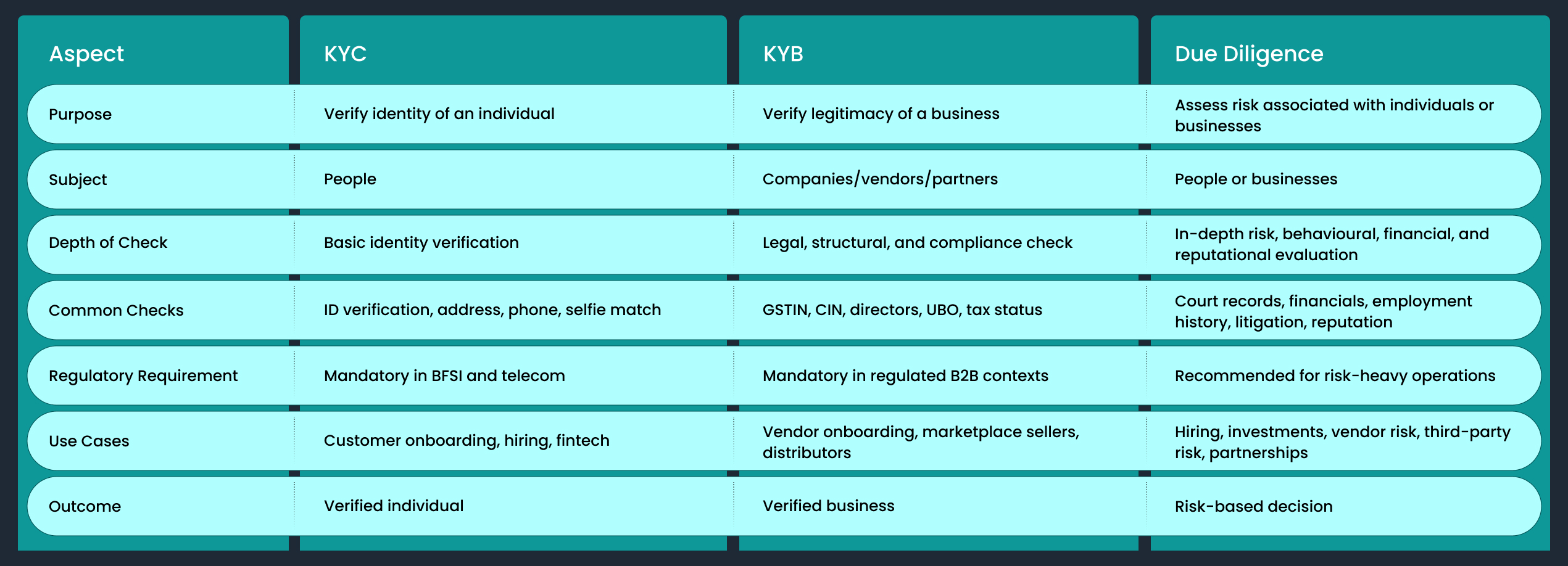
Where These 3 Overlap – and Where They Don’t
Overlap
- All three reduce financial, legal, and reputational risks
- All three support compliant onboarding
- All three are fundamental to trust-building
Differences
KYC = Identity
KYB = Legitimacy
Due Diligence = Risk
Together, they create a multi-layered trust framework used by modern organizations.
How Companies Are Evolving Their Trust Frameworks
The verification landscape is shifting from paper-heavy processes to digital-first, API-first, real-time trust systems.
Key trends include:
- Automated KYC & KYB workflows
- Layered risk-based due diligence
- Continuous monitoring of partners and vendors
- AI-powered fraud detection and pattern analysis
- Unified dashboards for all compliance stakeholders
Organizations today don’t just want verification—they want reliability, transparency, and ongoing trust.
Final Thoughts
KYC, KYB, and Due Diligence may seem like three different processes, but they all serve a single purpose: building trust in an increasingly digital world.
- KYC verifies individuals
- KYB verifies businesses
- Due diligence analyzes risk
Together, they help companies make confident hiring decisions, partner with the right vendors, and comply with evolving regulatory environments—without slowing down growth.






Leave a Reply