
Table of Contents
ToggleWhen companies talk about background verification, the focus is often on what needs to be checked: ID cards, degrees, or job history. But the real question is rarely asked: why do we verify differently for different roles?
The answer lies in the different degrees of trust and responsibility that each role demands. A freelancer on a two-week project, a mid-level manager leading a team, and a C suite responsible for billions in revenue occupy very different places in an organization’s trust hierarchy.
Verification, then, is not a uniform process. It is a calibration of trust.
Freelancers: The Trust of Access
Freelancers are outsiders granted insider access—systems, code, or confidential client data. Even if their engagement is short, the risk is immediate.
Here, verification is about confirming identity and legitimacy rather than conducting deep-dive investigations.
Common Checks for Freelancers:
- Identity Verification (PAN, Passport, or global equivalents).
- Address Verification (Digital/Instant) to ensure traceability.
- Basic Criminal Record Screening to flag obvious red signals.
Think of this as border control—quick, efficient checks that protect the ecosystem without slowing down project timelines
Employees: The Trust of Continuity
Full-time employees represent continuity and commitment. They interact with customers, handle sensitive data, and become part of company culture. A bad hire here doesn’t just hurt productivity—it can damage reputation.
Verification goes deeper, focusing on the consistency of a candidate’s story.
Common Checks for Employees:
- Identity & Address Verification as a baseline.
- Education Verification to confirm qualifications.
- Employment History Verification to validate past roles.
- Criminal Record Checks for workplace safety.
If freelancers are “border-crossers,” employees are residents. Their verification feels more like citizenship screening—slower, more detailed, but necessary for long-term trust.
Managers: The Trust of Influence
Managers shape teams, interpret company values, and influence decision-making. Their risks aren’t just transactional—they can cause cultural and operational damage if misaligned.
Here, verification shifts from documents to behavioral and ethical signals.
Common Checks for Managers:
- Detailed Employment Verification – not just job titles, but responsibilities and performance.
- Reference Checks – insights into leadership style and conduct.
- Certification/Professional License Verification – critical in technical or regulated roles.
- Credit History Checks – useful for roles with financial accountability.
At this level, verification is less about what’s on paper and more about how the person has led and what legacy they left behind.
C suites: The Trust of Stewardship
For C suites, trust moves beyond the individual to the organization’s credibility itself. A CEO or CFO doesn’t just execute tasks—they embody the company to investors, regulators, and the public.
Verification here is as much about reputation and integrity as it is about qualifications.
Common Checks for C suites:
- Regulatory & Compliance Screening (RBI, SEBI, international watchlists).
- Credit & Financial History Checks – ensuring fiscal responsibility.
- Reputation & Media Screening – adverse mentions, controversies, or ethical red flags.
- Exit Reason Verification – with past employers, especially for senior roles.
Here, verification is about protecting shareholder trust and brand equity.
The Trust Gradient
When mapped across roles, a trust gradient becomes clear:
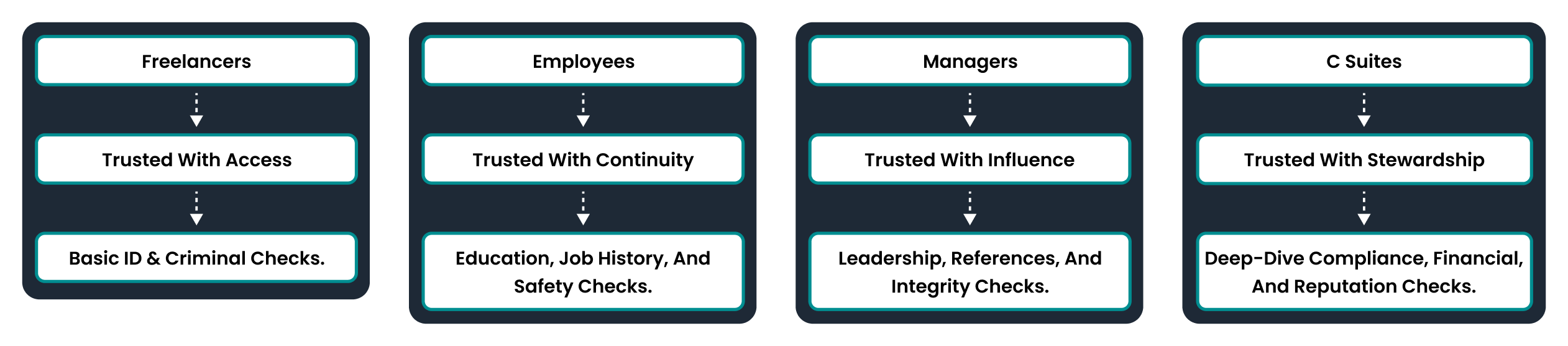
Each step up increases the radius of impact, and verification must deepen accordingly.
Why “Same for All” Doesn’t Work
A uniform checklist across roles is either wasteful or dangerous.
- Over-verifying freelancers increases costs and slows down hiring.
- Under-verifying C suites risks catastrophic reputational and financial damage.
The smarter approach is proportionality: verification that matches responsibility.
Beyond Compliance: Verification as a Cultural Signal
Verification is often treated as a compliance burden, but it is actually a signal of values.
- To freelancers, it says: you are part of a trusted ecosystem.
- To employees, it says: your workplace is safe and merit-driven.
- To managers, it says: leadership is built on integrity.
- To C suites, it says: you are held to the highest standards, because the organization is too.
In this sense, verification is not about policing—it is about institutionalizing trust.
The Future: Continuous & Role-Aware Verification
Static, one-time checks are giving way to dynamic models. Roles evolve, responsibilities change, and risk shifts. Tomorrow’s verification will be:
- Real-time for freelancers.
- Periodic for employees.
- Situational for managers.
- Continuous reputation monitoring for C suites.
This adaptive approach ensures trust doesn’t just start strong—it stays strong.
Conclusion
From freelancers to C suites, verification is not a uniform process. It is a spectrum of checks shaped by responsibility.
- Freelancers need light-touch checks for access.
- Employees require foundational checks for continuity.
- Managers demand deeper insights into leadership and ethics.
- C suites warrant exhaustive scrutiny for stewardship.
Organizations that understand this gradient of trust go beyond compliance. They build systems where every role—temporary or permanent, junior or senior—is trusted appropriately.
Because at the end of the day, verification isn’t about documents—it’s about scaling trust responsibly.





Leave a Reply