Table of Contents
ToggleFor decades, background verification has been a behind-the-scenes process. Candidates filled out forms, shared documents, and waited while employers or verification agencies combed through their past. It was procedural, sometimes invasive, and rarely transparent.
But today, a quiet revolution is underway — one that’s transforming verification from a process done to candidates into a process powered by them.
At the heart of this transformation lie two powerful ideas: digital consent and data portability. Together, they’re not just changing how background checks work — they’re reshaping the very notion of trust between individuals, employers, and data custodians.
The Broken Trust Loop
If you’ve ever been through a background check, you’ve likely experienced the fatigue:
Uploading the same ID proof for multiple employers. Re-entering your educational and employment history over and over again. Waiting for weeks while agencies “verify” information you already know is true.
The system works, but it’s deeply inefficient — and worse, it leaves you with little control.
- You don’t know who has your data.
- You don’t know how long they’ll keep it.
- You don’t know where it goes next.
This asymmetry of power — where data flows one way and consent feels like a formality — is what digital consent and portability seek to fix.
Digital Consent: From Checkbox to Conversation
Consent used to be a checkbox. You clicked “I agree” and moved on. But meaningful consent isn’t a formality — it’s a dialogue.
Digital consent reframes this exchange by giving people the ability to:
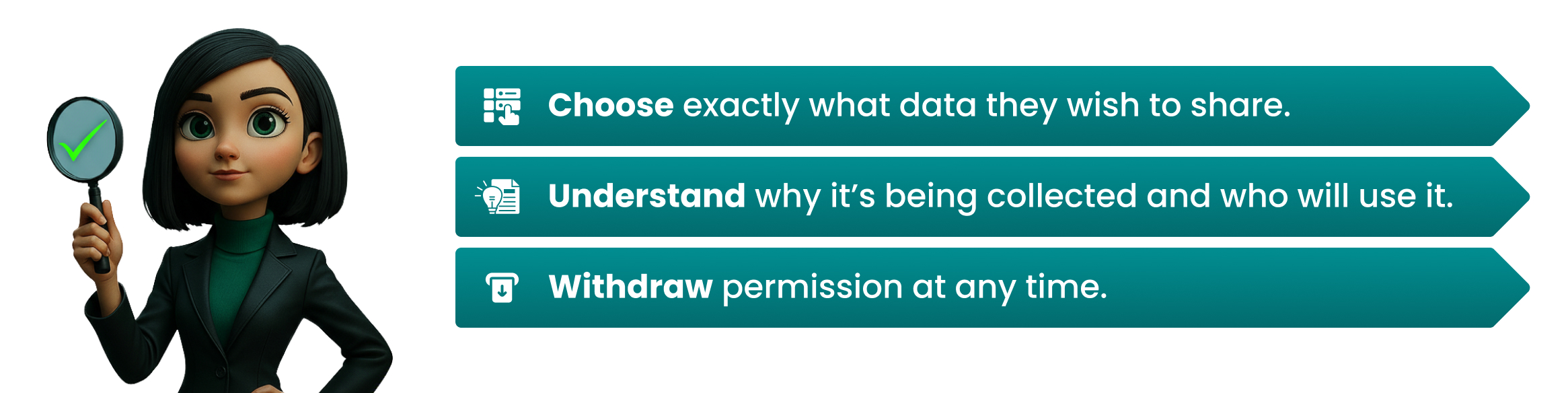
This isn’t just a compliance checkbox under India’s Digital Personal Data Protection Act (DPDP) — it’s a mindset shift. It places people back in control of their data and allows them to participate in decisions about their own identity.
In the context of background verification, digital consent changes everything. It means the candidate isn’t a passive participant anymore — they’re a co-owner of the process.
Data Portability: The Power to Carry Your Proof
Imagine if your verified employment record, education certificate, or address check didn’t need to be redone every time you switched jobs.
What if you could simply port your verified data, securely and instantly, from one employer to another — just like transferring money from one bank to another?
That’s the promise of data portability.
It transforms verification from a “start-from-scratch” process into a continuum of verified trust — a reusable digital reputation that travels with the individual.
For candidates, it’s empowerment.
For employers, it’s efficiency.
For the ecosystem, it’s evolution.
The Human Side of Compliance
When we talk about data rights, it’s easy to get lost in jargon — “fiduciary,” “consent architecture,” “portability framework.” But at its core, this is a human story.
It’s about people who shouldn’t have to relive the same verification cycle with every new opportunity.
It’s about trust built not through surveillance but through transparency.
And it’s about businesses that can grow faster because they can trust, instantly, what has already been verified once.
A digitally consented, portable verification framework doesn’t just tick compliance boxes. It creates dignity. It acknowledges that behind every data point — an address, a qualification, an employment record — there’s a person who deserves control.
India’s Moment of Reinvention
India stands at a fascinating crossroads.
With the DPDP Act taking shape, organizations are beginning to realize that privacy and productivity aren’t opposites — they’re allies. Consent and portability, when implemented right, can actually accelerate digital trust in ways that bureaucratic paperwork never could.
Platforms like OnGrid, which already operate at the intersection of data, verification, and trust, are uniquely positioned to lead this change. The goal isn’t just to verify faster — it’s to verify fairer.
By building frameworks where individuals can:
Control how their data is used,
Reuse verified information across jobs, and
Know exactly when and why their data moves —
India can become a model for people-first verification frameworks that are both privacy-respecting and business-enabling.
From “Background Check” to “Trust Network”
Let’s imagine a future scenario.
A young designer named Riya is switching jobs. Instead of filling endless forms, she opens her OnGrid profile — a verified locker that holds her identity proofs, education credentials, and employment history.
She grants digital consent to her new employer to view only the information they need — nothing more. The data transfer is instant, secure, and fully logged.
Riya sees who accessed her data and when. The employer receives verified records within hours, not days.
No paperwork. No repeated verifications. No blind trust — just transparent, verifiable trust.
That’s not just a better candidate experience. That’s a redefined contract between people and data.
The Business Case for Human Trust
There’s a misconception that privacy slows business down. In reality, the opposite is true.
When candidates know their data is respected, they cooperate faster. When employers can access verified data instantly, they onboard faster. When verification platforms can exchange data securely, they scale faster.
Here’s what digital consent and portability unlock for businesses:
- Speed: Verified data moves seamlessly between trusted parties.
- Savings: No repeated document collection or redundant checks.
- Compliance: In-built alignment with data protection laws.
- Trust Equity: A reputation for treating people’s data ethically.
In a market where employer brand and trustworthiness matter more than ever, being transparent about consent isn’t just compliance — it’s competitive advantage.
The Design Challenge Ahead
- Consent Architecture: Build intuitive, granular consent flows. Replace legalese with plain language and user-friendly toggles.
- Portability Framework: Develop interoperable data formats and APIs that can securely exchange verified information.
- Transparency by Design: Let candidates see their data’s journey — from collection to deletion.
- Audit & Accountability: Maintain immutable records of who accessed what, when, and why.
- Ecosystem Collaboration: Work with employers, verification partners, and regulators to create standards for portable verification data.
The Role of OnGrid
OnGrid has always believed that trust is not just a report — it’s a relationship.
As digital consent and data portability become the new norms, OnGrid’s mission expands from verification to empowerment.
- Empowering individuals to control and reuse their verified identities.
- Empowering employers to hire faster, with clarity and confidence.
- Empowering the ecosystem to align with emerging data laws through transparent, ethical design.
By integrating consent-led data flows and portable credential structures, OnGrid can help shape the next-generation verification framework — one where the balance of power tilts back toward the individual, without slowing down business.
The Future Is Portable, Permissioned, and Personal
In the coming years, we’ll look back and wonder why verification ever had to be so opaque.
Why did people have to give up so much control, so much privacy, just to prove who they were?
Digital consent and data portability change that narrative.
They turn verification into a mutual exchange of trust, not a one-sided transaction.
They bring human agency into a process that was once purely procedural.
And for platforms like OnGrid — and the businesses they power — that’s not just the future of compliance. It’s the future of credibility.
Final Thought
Every background check begins with a question: Can we trust this person?
But the next generation of verification frameworks will flip that question around:
Can this person trust us with their data?
The companies that can confidently answer yes to both will define the next era of digital trust.



Leave a Reply