
Table of Contents
ToggleIf you’ve worked with vendors long enough, you know this truth: problems rarely show up on Day 1. They build quietly—missed SLAs, inconsistent quality, unclear compliance—and by the time they surface, the vendor is already deeply embedded in your operations.
That’s exactly why a vendor audit checklist isn’t just a procurement document. It’s a control system.
You’re not just evaluating a supplier. You’re validating whether they can be trusted with sensitive data, critical processes, and ultimately, your brand.
What is a vendor audit checklist?
A vendor audit checklist is a structured framework used to evaluate a vendor’s reliability, compliance, and operational capability. It brings consistency to how vendors are assessed—whether at onboarding, during renewal, or in the middle of a crisis.
Think of it less as a checklist and more as a decision-making tool. Without it, audits tend to become subjective conversations. With it, they become structured evaluations backed by evidence.
At its best, a vendor audit checklist doesn’t just confirm what a vendor claims—it verifies how they actually operate.
Why vendor audits often fail
Most vendor audits don’t fail because of lack of effort. They fail because of lack of structure.
Teams review documents, ask a few standard questions, and move on. Everything seems fine—until something breaks months later. The issue lies in the gap between documentation and reality.
A strong due diligence checklist closes that gap. It ensures every vendor is evaluated using the same lens, every finding is backed by proof, and every gap leads to a defined action. More importantly, it shifts the audit process from reactive firefighting to preventive control.
When should you use a vendor audit checklist?
A common mistake is treating audits as annual rituals. In reality, a vendor audit checklist is most useful at multiple points in the vendor lifecycle.
It plays a crucial role before onboarding a new vendor, during contract renewals, when service quality starts slipping, or when the vendor’s scope expands. It also becomes essential during regulatory reviews or client-driven audits.
In industries where compliance and trust are non-negotiable, this isn’t just good practice—it’s expected.
What a strong vendor audit checklist actually covers
This is where theory often diverges from practice. Many templates list categories but don’t define what “good” looks like. A useful vendor audit checklist goes deeper. It connects what needs to be checked with the evidence required, the risk involved, and the action to be taken if something fails.
Here’s a practical structure that reflects how audits actually work on the ground:
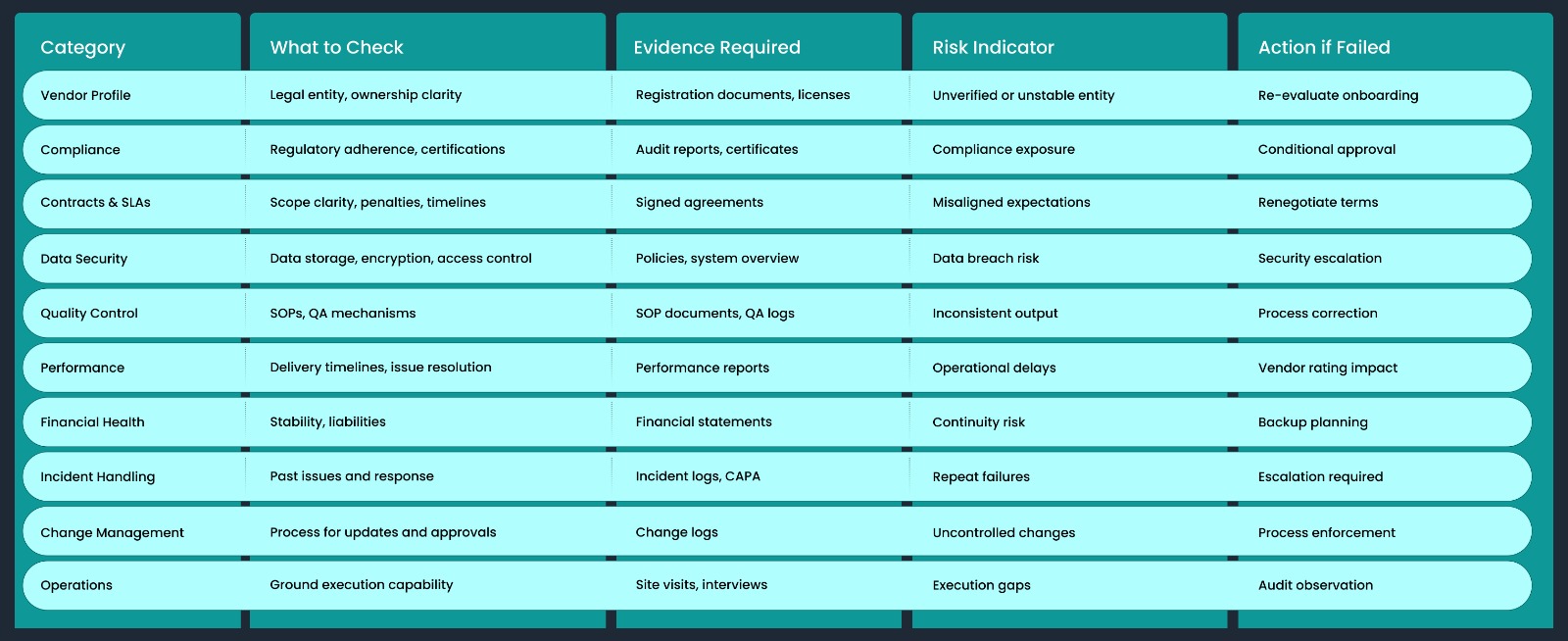
This kind of structure ensures the audit doesn’t stop at observation—it leads to action.
The layered approach that actually works
Not all vendors carry the same level of risk, and treating them equally often leads to either over-auditing or under-preparing.
More mature organizations segment vendors into risk tiers. Low-risk vendors are typically evaluated on documentation and basic compliance. Medium-risk vendors require performance tracking and periodic reviews. High-risk vendors—those handling sensitive data or critical workflows—demand deeper scrutiny.
For such vendors, audits go beyond documents. They include process validation, security architecture reviews, and sometimes even on-ground verification. This layered approach ensures effort is spent where the risk actually lies.
What really matters during an audit
Here’s something most frameworks won’t tell you: auditors are not impressed by well-designed checklists.
They look for evidence.
A strong vendor audit checklist always answers four questions clearly—what was checked, what proof supports it, what risk was identified, and what action followed. Without this, even the most detailed checklist becomes a formality.
In practice, the difference between a “completed audit” and a “useful audit” lies in how well this evidence is captured and acted upon.
Common mistakes that quietly create risk
Even experienced teams fall into patterns that weaken their audit process. One of the most common issues is treating the checklist as static. Vendor risks evolve, and so should the checklist.
Another is over-reliance on certifications. While useful, certifications don’t always reflect day-to-day operational discipline. There’s also a tendency to focus too much on documentation while ignoring execution reality.
Perhaps the biggest gap, however, is the lack of follow-through. Audit findings without closure mechanisms don’t reduce risk—they simply document it.
How vendor audit checklists are evolving
The idea of a vendor audit checklist is changing. It’s no longer just a spreadsheet used once a year.
Today, leading organizations are moving toward systems that are dynamic and continuous. Checklists are being integrated into workflows, updated based on risk signals, and supported by digital evidence like logs, images, and real-time data.
In high-trust ecosystems, audits are gradually shifting from periodic validation to ongoing assurance. The question is no longer whether a vendor was compliant last quarter, but whether they are compliant right now.
Final thought
Creating a vendor audit checklist is easy. Creating one that actually works requires intent.
It means going beyond surface-level validation and asking harder questions—not just whether a process exists, but whether it is followed consistently under real conditions.
In a world where operations are increasingly outsourced, your vendors play a defining role in your reliability. And often, the difference between a seamless operation and a hidden risk comes down to how seriously that checklist is designed, used, and evolved over time.






Leave a Reply