
Table of Contents
ToggleIf there’s one thing 2025 has made clear, it’s this: businesses in India can’t afford to treat data casually anymore. Customers are tired of spam calls, random emails, and apps that ask for more permissions than they actually need. The Digital Personal Data Protection (DPDP) Act isn’t just a law—it’s India’s way of telling organisations, “Handle personal data responsibly, or don’t handle it at all.”
But yes—compliance can feel intimidating. Most founders, marketers, CTOs, and ops teams are wondering the same thing:
“Where do we even start?”
That’s exactly why this checklist exists. It breaks down the Act into simple, human-understandable actions. No legal jargon. No fear-inducing tone. Just a clear, practical way to get compliant without losing your mind.
Governance & Accountability — Setting the Foundation
Before you start updating dashboards and rewriting privacy pages, take a moment to understand your role under the DPDP Act. Are you the one deciding why and how you collect data? Are you processing it on behalf of another company? Or do you fall into the “Significant Data Fiduciary” bucket because of scale or risk?
Once this clarity is locked in, fix your foundation. Every company—big or small—needs someone who owns this responsibility. Not someone “on paper,” but a real human who understands the stakes.
A strong governance foundation includes:
- A person customers can reach out to when they have data concerns
- A Data Protection Officer if your business is classified as significant
- Internal rules that explain to employees how to handle personal data
- Communication from leadership that privacy isn’t optional—it’s expected
This foundation is like a seatbelt. You don’t think about it daily, but when something goes wrong, you’re grateful it’s there.
Consent & Notice — Talking to Users Honestly
Let’s be honest: most people don’t read privacy notices. And most businesses write them hoping no one will.
But under DPDP, that era is over.
You now need a consent notice that feels like a normal human conversation. Something a teenager, an elderly parent, or anyone in a hurry can understand.
Your consent notice should clearly say:
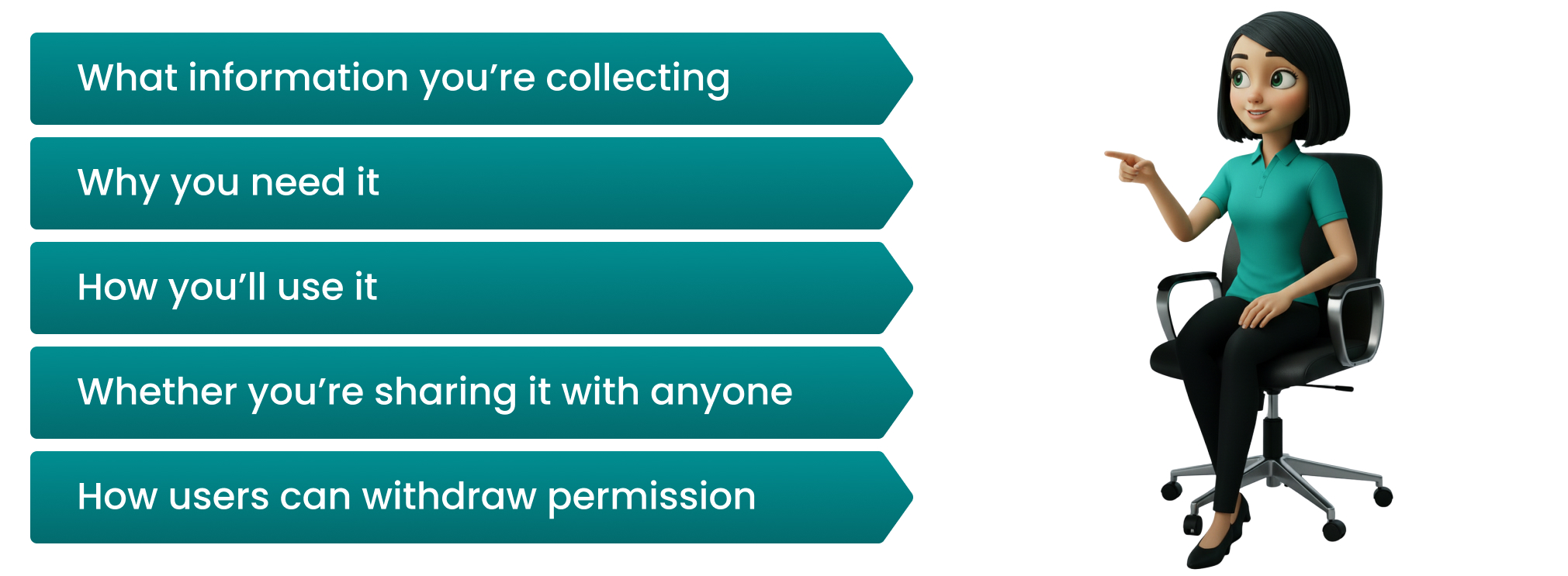
And behind the scenes, you need systems that can:
- Store consent proof
- Update it when someone withdraws consent
- Provide transparency when users ask for it
Think of consent as relationship hygiene. Clear communication avoids messy situations later.
Data Processing Principles – Using Data the Right Way
If the last decade was about collecting as much data as possible, the next decade will be about collecting only what’s essential.
The DPDP Act encourages organisations to process data with intention. That means:
- Specific purpose: No vague “for better services” explanations
- Minimal collection: Take only what you genuinely need
- Accuracy: Allow people to correct their data easily
- Retention discipline: Delete data when the job is done
This isn’t just compliance—it’s good business sense. The less data you hoard, the less risk you carry, and the easier your life becomes when audits or requests come in.
Security & Breach Preparedness – Protecting What You Hold
Security is where things get serious. Breaches don’t just cost money; they break trust. And trust, once gone, rarely comes back.
Under the DPDP Act, you’re expected to implement reasonable security safeguards. “Reasonable” doesn’t mean over-engineering everything. It means:
Keeping confidential data encrypted
- Limiting access so only the right people see the right information
- Regularly scanning your systems for vulnerabilities
- Training employees on basic data safety
If something still goes wrong (because mistakes happen), you must inform:
- The people affected
- The regulatory authority
And your explanation should be simple—not technical mumbo-jumbo.
A good way to prepare is:
- Maintain a breach-response playbook
- Keep templates ready for quick communication
- Assign a team responsible for emergency response
It’s better to rehearse and not need it than panic when the actual moment arrives.
Rights of Individuals – Giving People Control Over Their Data
One of the best parts of the DPDP Act is how it gives power back to individuals. People can finally understand and influence how their data is handled.
They can:
- Ask what data you’ve collected
- Request copies
- Correct wrong details
- Update outdated information
- Request deletion
- Withdraw consent
- Nominate someone to act on their behalf
To honour these rights, your systems must support:
- Easy request submission
- Verification without unnecessary hurdles
- Clear timelines
- Polite communication
- Logs that track every step
Treat every request like an opportunity to show that your business respects its users.
Children’s Data – Handling the Most Sensitive Set
If your app or service touches children’s data, your responsibilities increase tenfold. Children cannot fully understand the consequences of sharing data, so the law protects them aggressively.
This means:
- Using age-gates
- Getting verifiable parental consent
- Avoiding personalised ads
- Avoiding behavioural tracking
- Avoiding profiling
Even if you’re not targeting kids intentionally, your systems must ensure you’re not mistakenly collecting or misusing children’s data.
Working With Partners – Choosing Carefully
You might handle data responsibly, but what about the partners you work with—your CRM, your cloud provider, your freelancers, your marketing automation tools?
Under DPDP, outsourcing does not reduce your accountability.
So you must ensure your partners:
- Have privacy and security processes in place
- Understand your instructions
- Don’t misuse the data
- Inform you immediately about any breach
- Maintain the required level of compliance
Vendor management suddenly becomes a crucial part of privacy hygiene.
Documentation & Routine Audits – Staying Prepared
Compliance is not a one-time launch. It’s an ongoing habit.
Your organisation needs updated documentation that covers:
- What data you collect
- Why you collect it
- How it flows through your systems
- How long it’s stored
- Who it’s shared with
- What security measures protect it
Periodic audits help you catch issues early instead of waiting for an external authority to discover them. Businesses that audit regularly stay prepared, calm, and confident.
Grievance Redressal & Interactions With the Board
People will reach out. Questions will come. Complaints will arise.
DPDP expects you to welcome these conversations—not ignore or bury them.
Every organisation must:
- Provide a clear grievance channel
- Display contact details prominently
- Respond within a defined timeline
- Treat every grievance with respect
And if the Data Protection Board contacts you, your responses must be timely and transparent.
A smooth grievance system shows customers that your brand is dependable—not defensive.
Building a Privacy-First Culture – The Real Game Changer
This is where most companies fail. They deploy tools, rewrite policies, and think the job is done.
It’s not.
Privacy lives in the day-to-day decisions your employees make.
Building a privacy-first culture means:
- Training teams in simple, relatable ways
- Encouraging questions and healthy doubt
- Reviewing internal communication channels
- Rewarding responsible behaviour
- Making privacy part of onboarding
The real goal is to create a workplace where people naturally ask:
- Should we really collect this?
- Is there a safer way to do this?
- Will the user be okay with this?
When your culture supports these questions, compliance becomes automatic.
Conclusion: Compliance Isn’t Just Law – It’s Leadership
The DPDP Act isn’t here to slow down innovation or complicate business. It’s here to build trust in India’s digital future.
By following this checklist across the ten sections, your organisation can transform compliance from an obligation into a competitive advantage. Customers trust brands that respect their privacy. Teams feel safer working in companies that protect data. And businesses that adopt privacy-first thinking early are the ones that scale smoothly.






Leave a Reply