
Table of Contents
TogglePrivacy Is No Longer a Back Office Concern
For years, privacy sat quietly in the compliance corner—an obligation, a checklist, a cost center. HR teams treated it as something to “get through” during onboarding. Legal teams viewed it as risk mitigation. And most business leaders saw it as a necessary evil.
But something has changed.
Privacy is now a front-line issue. It’s shaping how we hire, how we build trust with candidates, and how we differentiate ourselves in a crowded talent market. In India, with the rollout of the Digital Personal Data Protection (DPDP) Act, privacy has officially entered the boardroom. And for companies that embrace it, privacy is becoming a strategic asset.
This is the 360° privacy revolution. And it’s just getting started.
The Old View: Privacy as a Burden
Let’s be honest. For most organizations, privacy has historically been reactive:
- “Let’s collect consent so we don’t get sued.”
- “Let’s mask Aadhaar numbers so we pass the audit.”
- “Let’s add a checkbox to the form and move on.”
This mindset created friction. Candidates felt overwhelmed by legalese. HR teams struggled with fragmented workflows. And compliance became a bottleneck—especially in high-volume hiring environments like staffing, logistics, and BFSI.
Privacy was seen as a blocker. Something that slowed down onboarding. Something that made verification harder.
But that view is outdated.
The Shift: Privacy as a Trust Signal
Today’s workforce is different. Candidates are more aware of their rights. They ask where their data goes. They want transparency. And they judge employers by how they handle personal information.
In fact, a 2024 Deloitte report found that 62% of job seekers in India consider data privacy practices when evaluating potential employers.
This is a wake-up call.
Privacy isn’t just about compliance anymore. It’s about trust. And trust is the currency of modern hiring.
What the 360° Privacy Revolution Looks
So what does it mean to embrace privacy as a business enabler? It means rethinking how we collect, process, and communicate around personal data—especially during onboarding and verification.
Here’s what the shift looks like in practice:
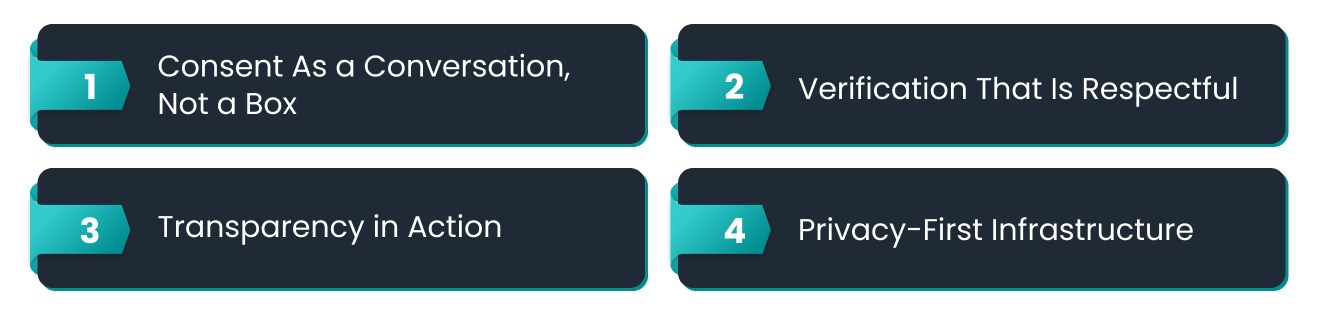
1. Consent As a Conversation, Not a Box
- Speak clearly, not lawyerly.
- Describe why data is being collected, how and when it’s being used and deleted.
- Enable the candidate to question and exclude unnecessary data sharing.
2. Verification That Is Respectful
- Collect only what is required for the job.
- Don’t overstep—don’t request documents that aren’t job-related.
- Use secure, time-limited access to sensitive information.
3. Transparency in Action
- Offer status updates in real-time during BGV.
- Let candidates know what’s being confirmed and by whom.
- Share results in context, not just a pass/fail indicator.
4. Privacy-First Infrastructure
- Invest in ISO-certified, audit-ready platforms.
- Have encryption, access controls, and data minimization be integrated into workflows.
- Approach privacy as a product feature, not a compliance band-aid.
Why HR Leaders Should Care
This is not a compliance narrative—it’s a talent narrative.
When privacy is treated properly, it instills confidence. Candidates feel respected. They’re more likely to join. They’re more likely to send others. And they’re more likely to remain.
Here’s what privacy-first hiring unlocks:
- More offer-to-join ratios Candidates who have faith in your process are less likely to fall off.
- Better employer brand Privacy conveys professionalism and integrity—particularly in regulated industries.
- Less onboarding nervousness Clear communication about data fosters psychological safety.
- Quicker time-to-productivity When verification is clear, candidates get involved earlier and more actively.
The Business Case: Privacy as a Differentiator
Let’s flip the narrative.
Instead of asking “How do we comply?”, ask “How do we compete?”
Privacy-first onboarding can be a strategic moat—especially in sectors where trust is fragile. Think gig platforms, NBFCs, staffing firms, and logistics providers. These are high-churn environments where candidates often feel commoditized.
By treating privacy as a differentiator, companies can stand out. They can attract better talent. They can reduce fraud. And they can build long-term loyalty.
In fact, a PwC India study from 2023 found that organizations with transparent data practices saw a 20% improvement in candidate satisfaction scores.
That’s not just compliance. That’s a competitive advantage.
The Cultural Shift: Privacy as a Value, Not a Policy
The most forward-thinking organizations don’t just comply with privacy laws—they embody privacy values.
They treat candidate data with the same care as customer data. They build internal cultures where privacy isn’t feared—it’s respected. And they empower HR teams to lead the charge.
This cultural shift is subtle but powerful. It shows up in how recruiters speak to candidates. In how onboarding flows are designed. In how verification outcomes are communicated.
Privacy becomes part of the employer brand. Part of the candidate experience. Part of the trust equation.
The Operational Shift: Privacy-First Hiring at Scale
Let’s talk logistics.
Scaling privacy-first hiring isn’t just about good intentions—it’s about good systems. HR teams need tools that make privacy easy, not harder.
That means:
- Automated consent capture with audit trails.
- Role-based access controls for sensitive data.
- Real-time dashboards for verification status.
- Secure document handling with expiry protocols.
- Candidate-facing portals that promote transparency.
When these systems are in place, privacy becomes frictionless. HR teams move faster. Candidates feel safer. And compliance becomes second nature.
The Strategic Shift: Privacy as a Growth Lever
Here’s the big idea: privacy isn’t just about risk—it’s about growth.
Companies that build trust with candidates onboard faster, retain better, and scale smoother. They avoid reputational hits. They reduce fraud. And they create hiring engines that are resilient, not brittle.
Privacy-first hiring is especially powerful in sectors like:
- Gig and blue-collar workforces Where verification needs to be fast, inclusive, and respectful.
- Financial services and lending Where compliance is non-negotiable and trust is everything.
- Staffing and temp agencies Where high-volume hiring demands scalable, secure workflows.
- Startups and scale-ups Where employer brand and agility are key differentiators.
In these contexts, privacy isn’t a checkbox—it’s a competitive edge.
What Needs to Change: A Call to Action for HR
If you’re an HR leader, here’s what you can do today to embrace the privacy revolution:
Rethink Your Onboarding Flows
- Audit your data collection forms.
- Remove unnecessary fields.
- Add contextual help and plain-language consent prompts.
Train Your Teams
- Educate recruiters and onboarding staff on privacy principles.
- Role-play candidate conversations around data sharing.
- Make privacy part of your culture, not just your policy.
Choose the Right Tools
- Use platforms that prioritize consent, transparency, and security.
- Avoid fragmented systems that create data sprawl.
- Look for vendors who treat privacy as a product, not a checkbox.
Communicate Your Values
- Add privacy commitments to your careers page.
- Share your approach on LinkedIn and in offer letters.
- Turn privacy into a brand pillar—not just a legal clause.
Conclusion: The Future of Hiring Is Privacy-First
We’re entering a new era.
Privacy is no longer a side note. It’s a strategic lever. It’s a trust signal. It’s a brand differentiator. And for HR teams, it’s a chance to lead.
The companies that win in 2025 won’t just be the ones with the fastest onboarding or the lowest cost per hire. They’ll be the ones that treat candidates like partners. That respect their data. That builds trust from day one.
This is the 360° privacy revolution. And it’s not optional.
It’s the future of hiring.




Leave a Reply