
Table of Contents
ToggleAddress verification used to mean clipboards, paper forms, and long waits. A field agent would visit someone’s home, click a photo, maybe ask a neighbor to confirm the name, and then report back after a few days.
That method worked — but only when people lived in the same place for years, and when companies could afford the time and cost of physical checks.
Today’s world looks very different. People move cities for jobs, work remotely, rent shared housing, and expect quick onboarding. Businesses, meanwhile, need faster, more accurate ways to verify identities and addresses.
This is where face match and geo-tagging are changing the game. Together, they’re turning address verification into a real-time, digital process — one that’s secure, scalable, and far more convenient for both companies and candidates.
Let’s unpack how this technology works, why it matters, and what the future looks like for address verification.
Why Address Verification Still Matters
Even in a world full of digital IDs and e-signatures, verifying where someone lives remains a key part of building trust.
For employers, it helps confirm that a candidate actually resides at the address they provided — which is often needed for compliance, security, or logistical reasons. For financial institutions and telecom providers, it’s a regulatory requirement tied to Know Your Customer (KYC) norms.
But traditional verification has always been slow and error-prone. Physical visits can take days, sometimes weeks, especially in rural areas. People move frequently, making old addresses unreliable. And manual data entry creates room for mistakes.
Companies needed a faster, fairer, and more reliable solution — one that keeps up with how modern India lives and works.
That’s where digital address verification, powered by geo-tagging and face match, comes in.
What Is Geo-Tagging in Address Verification?
Geo-tagging simply means attaching geographical coordinates — latitude and longitude — to digital content like a photo, video, or document.
When used for address verification, it works like this:
- The candidate takes a live photo of their home using a mobile app.
- The app automatically records the GPS coordinates of where the photo was taken.
- These coordinates are then compared with the address provided in the candidate’s profile.
If they match within an acceptable range, the address is verified instantly. No field visit. No delay.
Geo-tagging adds objectivity to the process. Instead of relying on someone’s written word, it uses hard location data that’s embedded in the image metadata and authenticated by the system.
What Is Face Match and Why It Matters
Face match (or face recognition) adds another layer of validation to ensure that the person submitting the address proof is the same individual applying for verification.
Here’s how it typically works:
- The candidate is asked to take a selfie through a secure mobile app.
- The app compares this live image with a verified ID photo (for example, PAN, or passport).
- The system checks for live presence — making sure it’s not a static image or printed photo being held up to the camera.
- If the facial features match within a defined confidence range, the verification is approved.
By combining face match with geo-tagging, companies can confirm both who the person is and where they are — in real time.
It’s a smart way to eliminate fraud while reducing manual steps.
The Benefits of Face Match and Geo-Tagging
Let’s look at why these two technologies are gaining so much attention in the verification world.
1. Speed and Convenience
A process that used to take days can now be done in minutes. The candidate simply uses a phone to verify their address, and the company receives instant confirmation.
That’s a huge advantage for sectors like logistics, gig work, fintech, or remote hiring — where every hour saved matters.
2. Accuracy and Traceability
Geo-tagging ensures the data isn’t just self-reported but verifiable through GPS coordinates. Face match ensures authenticity. Together, they make tampering almost impossible.
3. Scalability
Companies hiring across thousands of locations can now verify addresses without dispatching field agents everywhere. The process scales effortlessly with automation.
4. Lower Cost
Traditional verification often involves travel expenses, manual labor, and paperwork. Digital verification cuts those costs drastically while maintaining accuracy.
5. Candidate Experience
A clunky verification process can frustrate candidates before they even start the job. A simple mobile-based check feels modern, fast, and respectful of people’s time.
How These Technologies Work Together
The real power lies in combining both tools.
Step 1: Live Selfie (Face Match)
The system confirms that the person verifying the address is the right individual.
Step 2: Address Photo (Geo-Tagging)
The app captures the live location data and links it to the photo of the premises.
Step 3: Cross-Verification
The system compares the captured location with the submitted address. If it falls within a defined radius, the address is confirmed.
Step 4: Report Generation
The results, complete with time stamps, coordinates, and verification logs, are sent back to the employer or client.
All of this happens securely, often within minutes.
The Evolution of Address Verification
We’re witnessing a major shift in how verification works. It’s moving from physical to digital, and from document-based to presence-based.
Here’s what that evolution looks like-
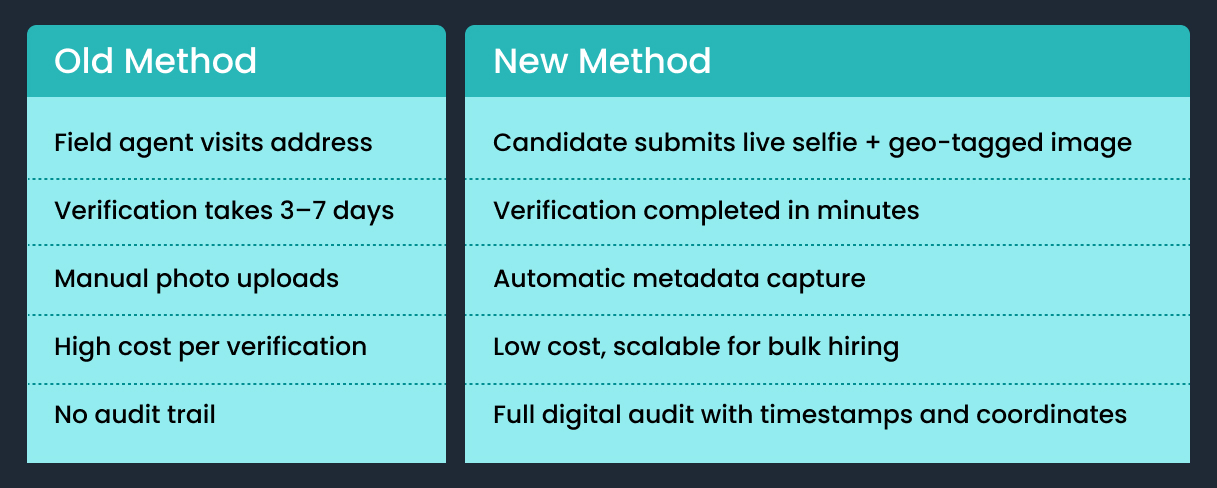
This transition is especially important in fast-moving industries where hiring speed defines competitiveness. Companies that adopt these tools early gain a clear operational edge.
The Future: Smarter, Safer, and More Connected
The next generation of address verification will likely combine even more technologies:
AI-powered Face Liveness Detection
Systems that can tell whether a selfie is from a real person or a spoofed video.
Blockchain-Based Verification Logs
Immutable records of each verification event to ensure data integrity and auditability.
Multi-Layered Address Validation
Combining geo-tagging, digital maps, and government datasets to cross-check accuracy.
Self-Service Verification Portals
Candidates will be able to verify once and reuse that verification for multiple employers.
The overall goal is simple: make verification so quick, secure, and transparent that it fades quietly into the background — just another trusted step in digital onboarding.
Final Thoughts
Face match and geo-tagging are more than tech buzzwords — they’re the backbone of modern address verification. They make it possible to confirm identity and location in real time, without the cost and delay of physical visits.
Used responsibly, they build trust on both sides: companies get verified data, and individuals get a fast, transparent experience.
As remote work, digital onboarding, and compliance needs grow, these technologies will only become more essential.
The future of address verification is already here — faster, smarter, and fairer than ever.






Leave a Reply