
Table of Contents
ToggleNot long ago, HR talk was filled with buzzwords—culture, engagement, retention. Those still hold weight, but if you take an HR head out for a sit-down chat nowadays, you’ll notice a different type of worry entering the room. It’s about risk, compliance, and trust.
In an era of faster, digital, and even remote hiring, those checks no longer pass muster. A résumé can appear fabulous, but is it credible? A reference can sound fantastic, but is it authentic? For firms that do business in highly sensitive industries such as financials, health care, or logistics, one bad move can result in regulatory attention, reputational harm, or worse, a loss of customer confidence.
And that’s where data-driven verification brings its quiet strength. It isn’t sexy. It doesn’t headline HR conference panels. But get someone who has ever been burned on a bad hire, and they’ll assure you—it’s the kind of ground you only take for granted when it’s sheltering you from a storm.
Read more: How AI is Transforming Document Verification in 2025
Beyond the Resume: Why Verification Became Strategic
A couple of years ago, a big services company in Mumbai learned something disturbing. One of the people they had recruited into a compliance-focused position hadn’t actually finished the degree they had claimed on their resume. It wasn’t even cynical on the face of it—maybe just desperation to get a job—but the implications were serious. The client agreement required that some positions be filled by individuals with certain credentials. Now, one lie was set to sabotage an entire engagement.
This is the tricky part: background checking isn’t being a detective. It’s ensuring business continuity and assuring the commitments entered into with clients, regulators, and customers are fulfilled.
The better news is that the process has changed. Verification now is not the arduous, manual experience it was in the past. Data-driven systems, many of which are driven by AI, can verify employment records, addresses, criminal cases, or professional licenses instantly. That means HR leaders aren’t waiting weeks to get people working; they’re making decisions in real time.
But more significantly, the findings don’t end at “yes/no.” Trends develop—sectors where resume padding is widespread, typical employment breaks, or geographic areas where document falsification spikes. Those trends provide HR with a strategic advantage.
The Human Element in Data
Here’s the catch: data never substitutes for judgment. It only refines it.
As an example, a candidate has a six-month employment gap. On paper, that’s a red flag. But the numbers don’t tell the story here—they might be illness, caregiving, or even upskilling. A quality HR manager sees verification insights as a starting point, not the end point.
This is where most businesses fail—they use background screening as a seal of endorsement rather than a means to improve dialogue. Done properly, data-driven HR doesn’t only filter out danger; it creates trust. Staff understand that the work environment is secure, coworkers have been screened, and everyone has an equal playing field.
Instant Verification: A Game-Changer
Speed is essential. Anyone who’s recently been hired understands that qualified candidates don’t linger. If your process is too slow, you lose them.
And that is where instant verification has made all the difference. With AI-powered systems, HR can verify key points—identity, work history, financial alerts—within minutes. That’s priceless for scaling companies quickly. Picture a gig-economy platform adding thousands of delivery partners in a matter of weeks. Without instant checks, the whole model would fail under the weight of delays.
And it’s not all about speed. Real-time insights equate to fewer blind spots. If a discrepancy appears in an address or if an employment history doesn’t match, HR finds out right away. That lowers risk and the embarrassment of finding things once a person is already in the system.
Compliance Is Not Just Legalese
If you’ve ever been involved in a client audit, you realize how merciless compliance can be. Forgetting a verification, bypassing a criminal record search, or overlooking an employment gap can easily escalate into penalties or reputational losses.
Data-based validation provides a safety net here. Each check is recorded, each choice is traceable. That means HR leaders don’t merely have compliance—they have evidence of compliance. If regulators or clients pose difficult questions, responses are supported by documentation, not memory.
In industries such as BFSI, where the error margin is narrow, this has shifted from being best practice to being unacceptable.
The Softer Role of Insights in Decision-Making
It’s easy to imagine verification as being all about risk and compliance. But the more you examine the data, the more it begins to creep into day-to-day decisions in subtle ways.
Think about workforce planning. If validation findings indicate that a high percentage of candidates in particular geographies always fail address verifications, HR can anticipate and revisit sourcing processes. Or if exit verification indicates recurring inconsistencies within a particular department, that could be indicative of underlying cultural or management problems.
These aren’t hot takeaways. They’re the sort of subtle prods that assist HR in making improved decisions—where to intensify recruitment efforts, how to hone job postings, when to increase checks, and when to reduce them. Cumulatively, throughout time, these prods work to create a safer, more intelligent workplace.
Continuous Monitoring: Trust Doesn’t Stop at Hiring
One area of blind spot in conventional HR procedures is that confirmation is held to be a one-time process. Candidate onboards, check is run, file closes. Yet circumstances with people do change. Financial difficulty, legal conflicts, or new professional certifications can all arise subsequent to the hire.
That’s why ongoing monitoring is becoming popular. With automation and AI, businesses can now implement systems wherein the records of employees are re-verified from time to time. It’s not policing—it’s being ahead of risks that could impact both the organization and the person.
For instance, in financial transaction-sensitive roles, constant monitoring of credit history or court records can warn HR of problems early so that assistance or intervention is available before things get out of hand. Employed judiciously, it safeguards both parties.
Where AI Fits In
There’s usually anxiety around AI in HR. Will it be decided for us? Will it supersede human judgment? In background verification, the use of AI is more utilitarian. It assists in three areas:
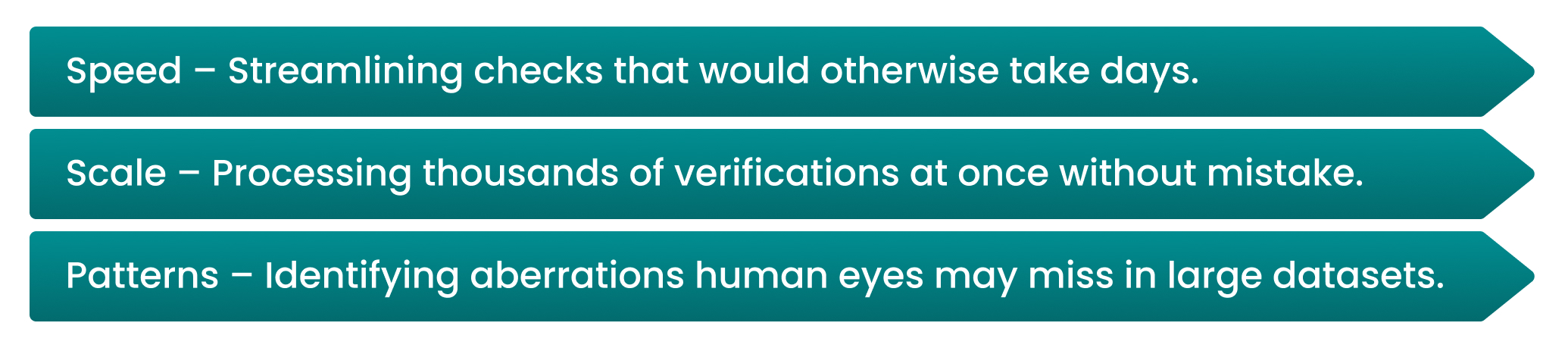
The last call remains with HR. What AI can provide is efficiency, precision, and the capability to concentrate human judgment on the cases that are most important.
The Cultural Aspect of Safe Workplaces
When workers understand that the firm cares about verification, it sends a message. It conveys: we are concerned about safety, fairness, and accountability. This cultural cue tends to be underappreciated.
I’ve seen workplaces where new hires casually talk about how rigorous the checks were. Far from resenting it, they took pride in being part of a system that values integrity. That kind of shared trust doesn’t show up in KPIs, but it has real effects—reduced attrition, stronger client confidence, and a healthier workplace atmosphere.
The HR function has ever been people, but the equipment at its disposal has evolved. Data-driven verification is one of those stealthy tools—it doesn’t blind, but it grounds.
As recruitment becomes more online, more dispersed, and more international, the value of trustworthy verification will increase. AI-facilitated instant checks, ongoing monitoring, and discreet insights from patterns aren’t merely functional enhancements. They are part of a wider transformation in how organizations establish trust and resilience.
For HR leaders, the challenge is not whether to adopt these tools—it’s how to embed them in a way that strengthens culture rather than reduces people to data points. Used well, verification insights don’t strip humanity from HR; they protect it.
Because at the end of the day, the safest, most compliant workplaces aren’t built by systems alone. They’re built by people making better decisions, supported by the right information at the right time.



Leave a Reply